 1986
1986USAID DEC
USAID. BUR. FOR SCIENCE AND TECHNOLOGY. OFC. OF ENERGY
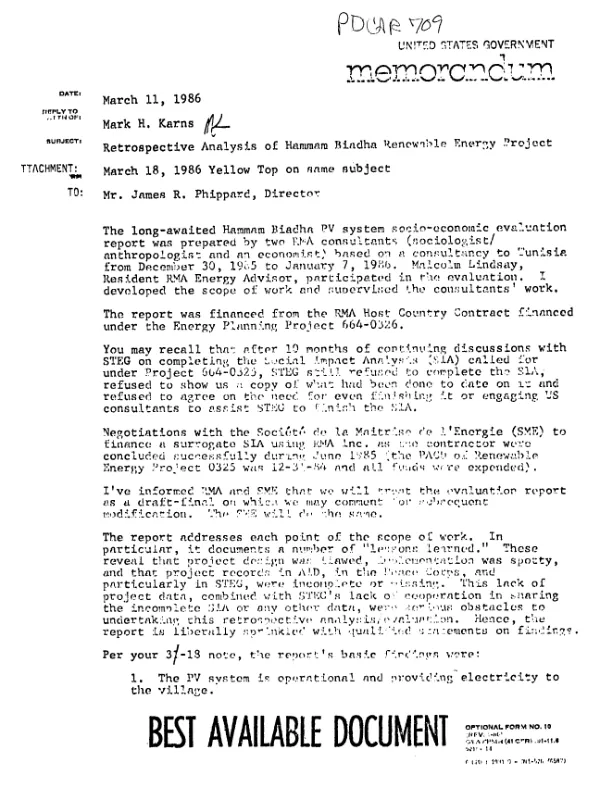
Evaluates pilot project sponsored by the National Aeronautics and Space Administration (NASA) to install a Solar Power Corporation refrigerator/freezer (SPC R/F) in Zaire"s Kionzo Mission as a way of assessing the effect of photovoltaic equipment on rural health care, in this case, vaccine preservation.
Rectenwald, Debra A.; Kabasele, Mulamba wa · 1985
Abstract
Final PES covers the period 8/82-6/85 and is based on a questionnaire and visits to the project site, a related project site, and local companies. Although solar refrigeration could be a dependable energy source for rural areas, the SPC R/F was not a sound investment. A simpler, more durable, less expensive, and more easily maintained refrigerator would have been more appropriate. While the SPC R/F was readily accepted by the Mission and did improve management of its vaccination program, there was a major problem with routine maintenance due to a lack of qualified local technicians; 7 of 9 SPC R/F"s at a related project encountered similar maintenance troubles. In addition, the SPC R/F units were unnecessarily complicated and too difficult to maintain when compared to simpler refrigerators, and the effectiveness of solar refrigeration would have been more revealingly tested at a location without alternative means of refrigeration. NASA"s attempt to monitor the project from the United States did not work well; requests for spare parts and TA have gone unanswered, so that the Kionzo nuns now have an expensive piece of equipment which has been broken down for almost a year and feel abandoned. Lessons learned are that any mechanical/electronic equipment installed in rural Zaire needs constant monitoring and that project management must be onsite. Based on project experience, it is recommended that: (1) USAID and other donors either subsidize solar equipment until its price is reduced or find ways to provide credit for rural photovoltaics; (2) more Africa-based research be conducted to determine which solar refrigerator parts are essential and which parts are superfluous for practical operating needs in rural Zaire; and (3) USAID design its pilot projects in a more systematic fashion, possibly by designating a qualified team to design, monitor, support, and evaluate pilot projects.
Connected topics
Classification