USAID. MISSION TO KENYA
National agricultural research
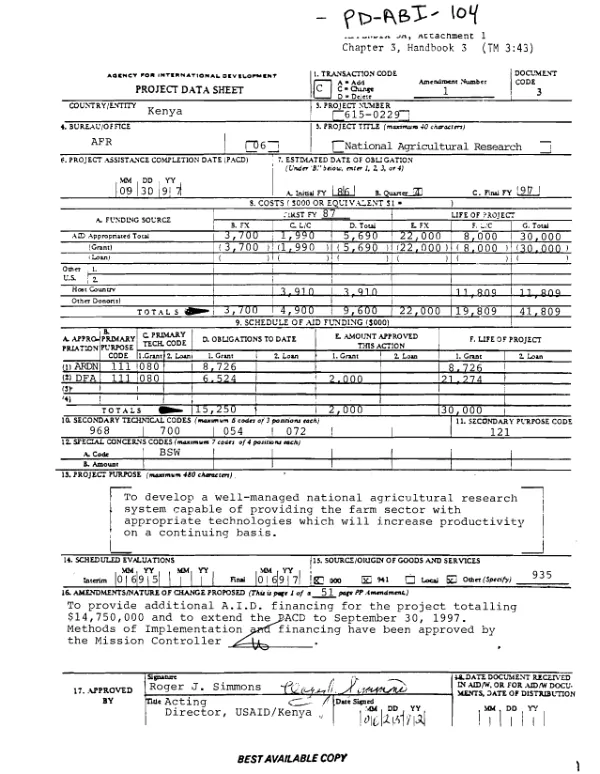
Project to restructure Kenya"s agricultural research system under a single entity, the Kenya Agricultural Research Institute (KARI), and to further upgrade agricultural research through improved commodity research, extensive training, and funding for private and university-based research.
1986
Sign in to readA free account is required to download.
Abstract
KARI and the Ministry of Agriculture and Livestock Development (MOALD) will implement the project -- a 10-year effort, the first 4 years of which are authorized in the Project Paper. The Government of Kenya will appoint a Board of Managers, Executive Officers, and managerial and technical staff for KARI, which will assume responsibility for previously dispersed research management functions. Two long-term advisors will help KARI to implement new management and administrative procedures relating to resource allocation within and across commodity programs, financial accountability, station maintenance, personnel development, and information systems. KARI"s National Maize and Sorghum/Millet commodity research will be upgraded. TA personnel will help KARI to design national coarse grain research activities and to develop an adaptive testing system, including on-farm work, able to provide recommendations for varied agro-ecological zones. On-the-job training will be provided to local technicians. On-the-job training and study tours will be provided for managers and KARI scientists, while 80 M.S. and 55 Ph.D. degrees will be provided for scientists over the planned 10-year project life. Graduate training will focus during initial years on maize and sorghum/millet research; 54 of the Masters" will be earned at the University of Nairobi, the remainder of the degrees at overseas (mostly U.S.) institutions. In-service training and seminars and workshops will be conducted for station support and technical staff in Kenya. A fund will be established to enable KARI to contract supplementary research from private or university researchers, and to provide grants to these same personnel for innovative, problem-oriented research proposals. Limited, short-term training opportunities will be available to the private sector, possibly with matching funding from Rotary International. Activities during the first 4 years will focus on planning, management, and establishment of appropriate research methodologies. Implementation of longer-term research will be the focus of Phase II. Amendment of 6/25/92 authorizes Phase II and extends the PACD to 9/30/97. A major focus of Phase II will be to institutionalize the Research Planning and Management system being established within KARI, with emphasis on developing a management information system and establishing a planning and budgeting process. Also in Phase II: (1) the focus of commodity research will shift from cereals, which are expected to be well institutionalized within KARI by 1994 toward high-value horticultural crops -- small ruminants research will incorporated as well; (2) human resources development will be dropped as a separate component and integrated with other project activities. (PD-ABI-104)
Related documents