USAID. MISSION TO MALI
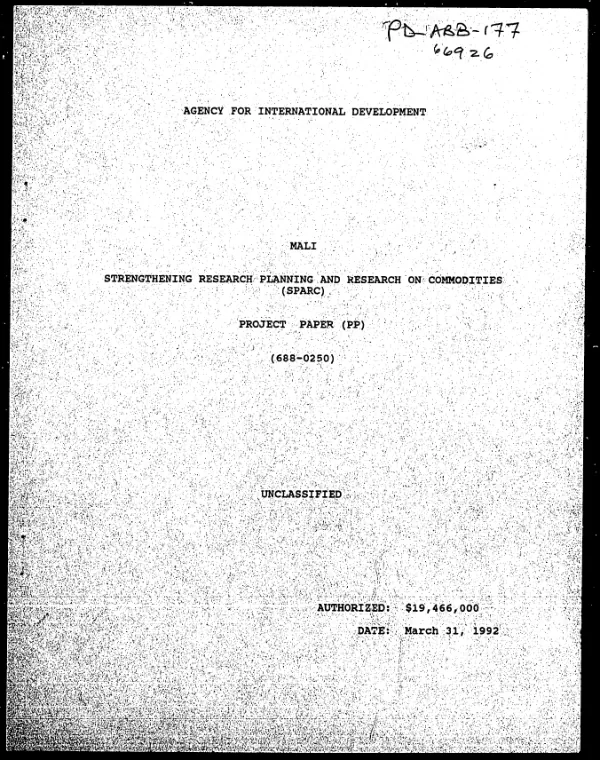
Strengthening research planning and research on commodities (SPARC)
Project to strengthen the capacity of Mali"s Institut d" Economie Rurale (IER) to develop and disseminate sustainable and productive technologies for small farmers.
1992
Sign in to readA free account is required to download.
Abstract
Texas A&M University (TAMU) and the International Service for National Agriculture Research (ISNAR) will implement the four project components: core research, research planning and management, researcher training, and institutional linkages. The project will support multidisciplinary research in priority areas of three core IER programs: (1) cereals and legumes, especially millet, sorghum, and cowpeas, and food technology; (2) animal production, with a focus on animal nutrition; and (3) production systems and rural economy, with respective emphases on farmer-oriented systems and socioeconomic research. These programs will be implemented at three regional research centers (Sotuba, Niono, and Mopti) encompassing five primary research locations (Sotuba, Niono, Mopti, Cinzana, and Koporo). Project-supported programs are expected to establish management, planning, financing, and monitoring models that IER will be able to use institute-wide. To strengthen research planning and management, the project will help IER to develop a multi-year planning process, long-term research priorities, and new procedures for reviewing research results. IER"s research process will be decentralized to the regional level in order to promote client feedback, team-based technology development, and field-level testing of new technologies. The project will also develop research monitoring and financial management systems for IER. Under the Thomas Jefferson Fellowship Program, the project will support U.S. or third country training for 19 IER researchers (10 M.Sc."s, 9 Ph.D."s). Short-term in-country training in such areas as biometrics, experimental design, and research station management, as well as in- and out-of-country workshops and conferences and short courses will also be funded. The project will also strengthen IER"s institutional linkages. In particular, the project will: (1) strengthen research-extension linkages via annual regional research planning sessions involving commodity and farming systems researchers and managers, agents of regional extension organizations, and farmers; (2) integrate on-farm and station research via a program of multi-locational trials; and (3) expand IER"s linkages with international agricultural research organizations and Collaborative Research Support Programs, as well as with the private sector and nongovernmental organizations.
Related documents