USAID DEC
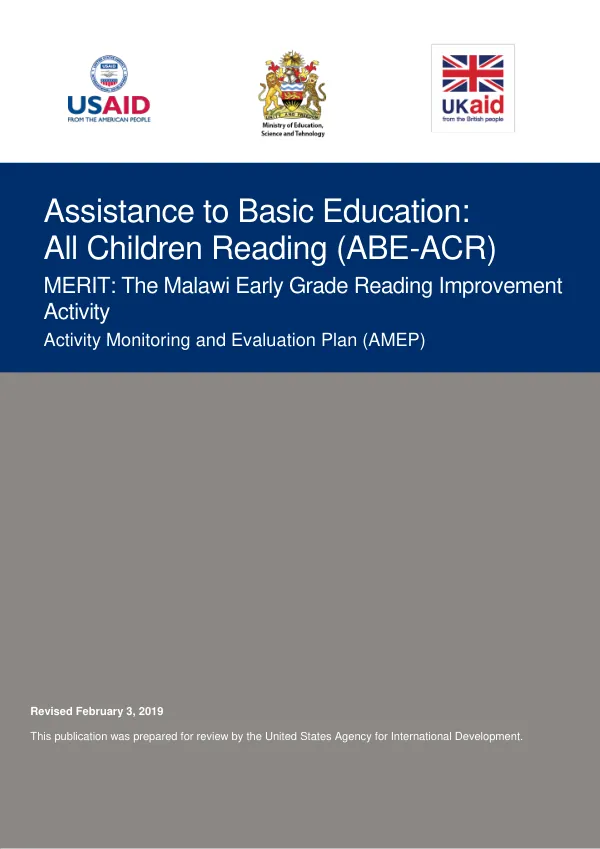
National Assessment of Safety, Gender, and Inclusion in Early Grade Reading Environments, March 2018
Sign inINDONESIAN MINISTRY OF RESEARCH, TECHNOLOGY, AND HIGHER EDUCATION
National Assessment of Safety, Gender, and Inclusion in Early Grade Reading Environments, March 2018
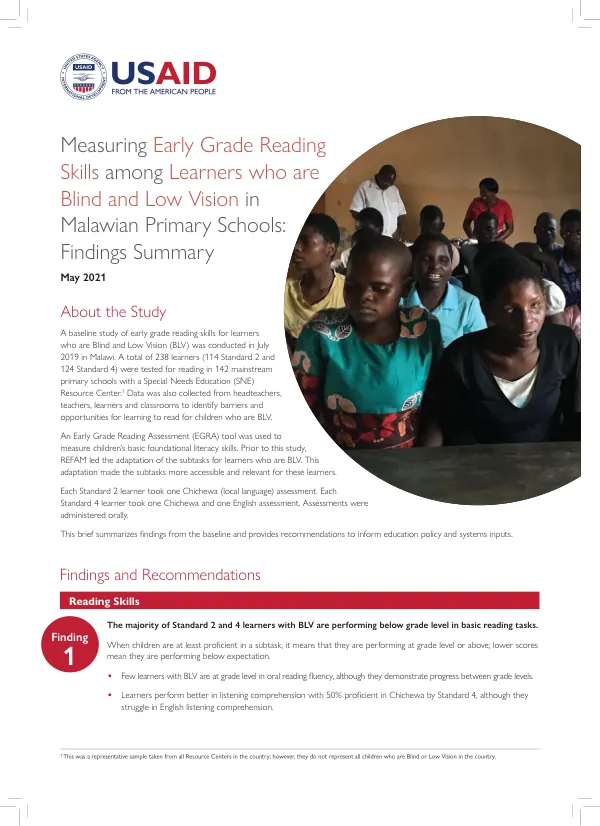
The Malawi Early Grade Reading Improvement Activity, also known as MERIT, is a program initiated by the United States Agency for International Development (USAID) to improve reading instruction in Malawi's primary schools.
2018 · 73 pages
Sign in to readA free account is required to download.
Abstract
The program focuses on creating safe, gender-responsive, inclusive, and supportive learning environments that enable students to reach their potential. MERIT's Objective 3 is designed to support the implementation of Malawi's National Reading Programme (NRP) across the country. MERIT's training activities were implemented with Standard 1 teachers only before data collection, and the National Assessment of School Inclusion and Safety (NASIS) data collection serves as a true baseline for the study. The NASIS was conducted from February to March 2017 across a randomized national sample of 86 Ministry of Education, Science and Technology (MoEST) primary schools. The assessment collected data at the school level and from teachers in Standards 2, 3, and 4 from each of the 86 schools. The NASIS assessed the four key elements of learning environments, which are physical and emotional safety, positive reinforcement, gender-responsiveness, and inclusive education. These elements are essential for creating a holistic model of safe reading environments. The assessment collected multiple forms of data concerning each of the four elements, including school observations, interviews with head teachers, focus group discussions with students, and classroom observations. The assessment found that physical and emotional safety is a significant concern in Malawi's schools. Many schools have unsafe grounds or behaviors, and students often face physical and emotional abuse. However, the assessment also found that some schools have made efforts to create safe and inclusive environments, such as having mission statements, school rules, and codes of conduct. The assessment also found that positive reinforcement is an essential element of learning environments. Teachers who use positive reinforcement, such as calling on students or providing positive feedback, have a significant impact on student learning outcomes. However, the assessment found that some teachers do not use positive reinforcement, and instead use punitive measures to discipline students. The assessment also found that gender-responsiveness is an essential element of learning environments. Girls and boys have different learning needs and preferences, and teachers who are aware of these differences can create more inclusive and supportive learning environments. However, the assessment found that some teachers do not take into account the different learning needs and preferences of girls and boys. The assessment also found that inclusive education is an essential element of learning environments. Students with disabilities and students from different cultural backgrounds often face barriers to learning, and teachers who are aware of these barriers can create more inclusive and supportive learning environments. However, the assessment found that some schools do not have inclusive education policies or practices in place. Overall, the NASIS assessment found that Malawi's schools face significant challenges in creating safe, gender-responsive, inclusive, and supportive learning environments. However, the assessment also found that some schools have made efforts to create these environments, and that teachers who use positive reinforcement, are gender-responsive, and provide inclusive education can have a significant impact on student learning outcomes.
Related documents
Documents in this collection
 2011
2011USAID DEC
Malawi Teacher Professional Development Support Program: A Study on the Quality of Primary School Curriculum Materials for Standards 3 and 4
Open record 2016
2016USAID DEC