USAID DEC
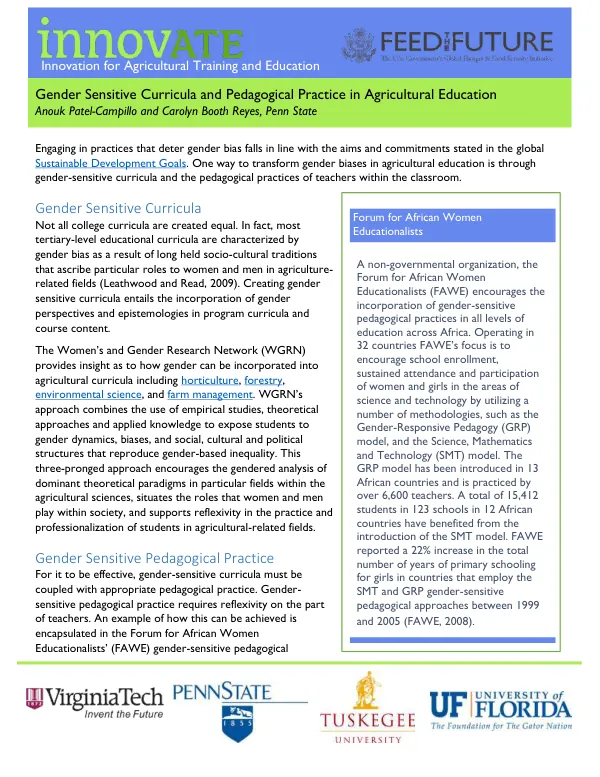
Innovation for Agricultural Training and Education: Gender Sensitive Curricula and Pedagogical Practice in Agricultural Education
Sign inUNITED NATIONS EDUCATIONAL, SCIENTIFIC, AND CULTURAL ORGANIZATION
Innovation for Agricultural Training and Education: Gender Sensitive Curricula and Pedagogical Practice in Agricultural Education
The agricultural education sector has been criticized for perpetuating gender biases, which can limit the participation and potential of women and girls in agricultural-related fields.
2016 · 3 pages
Sign in to readA free account is required to download.
Abstract
To address this issue, the development of gender-sensitive curricula and pedagogical practices is essential. These approaches aim to incorporate gender perspectives and epistemologies into educational programs, promoting a more inclusive and equitable learning environment. Gender-sensitive curricula involve the incorporation of gender analysis and critical thinking into course content, encouraging students to examine the social, cultural, and political structures that reproduce gender-based inequality. The Women's and Gender Research Network (WGRN) provides a framework for incorporating gender into agricultural curricula, including horticulture, forestry, environmental science, and farm management. This approach combines empirical studies, theoretical perspectives, and applied knowledge to expose students to gender dynamics, biases, and social structures. Effective gender-sensitive pedagogical practice requires reflexivity on the part of teachers, who must be aware of their own verbal and non-verbal cues when interacting with students. The Forum for African Women Educationalists (FAWE) has developed a gender-sensitive pedagogical approach that encourages educators to be mindful of their attitudes and behaviors in the classroom. FAWE's approach includes experimenting with classroom set-up and activities to promote girls' participation, engaging local women leaders and role models to promote awareness about women in science, technology, engineering, and mathematics (STEM) fields, and organizing science camps to dispel gender stereotypes. The UNESCO training module manual provides specific guidelines for educators to discuss the difference between gender and sex in a classroom setting, targeting teachers, career guidance counselors, and school administrators who are interested in promoting women in science. Additionally, the manual highlights the importance of cultural beliefs and values that may create barriers for women in the classroom, such as the belief that gender roles are biologically determined. University administrators and faculty in the agricultural sciences can make a significant impact by implementing gender-sensitive curricula and pedagogical practices in their classrooms. This can help to alert and sensitize students to the biases that plague women and other marginalized populations, promoting a more inclusive and equitable learning environment. By taking proactive steps to address gender bias, educators can make great strides toward eradicating these biases and promoting greater diversity and inclusion in the agricultural education sector. The development of gender-sensitive curricula and pedagogical practices requires a range of resources and tools. The UNESCO and International Bureau of Education (2012) publication, "Gender and the Curriculum: A List of Resources," provides a comprehensive list of resources for creating gender-sensitive curricula. Additionally, the UNESCO (2004) manual, "Gender Sensitivity: A Training Manual for Sensitizing Education Managers, Curriculum and Material Developers, and Media Professionals to Gender Concerns," offers a structured approach to gender-sensitive training for educators. The Central Board of Secondary Education of India's "Checklist for Gender Sensitivity in Schools" provides a practical tool for school administrators to assess and improve gender sensitivity in their institutions.