CHEMONICS
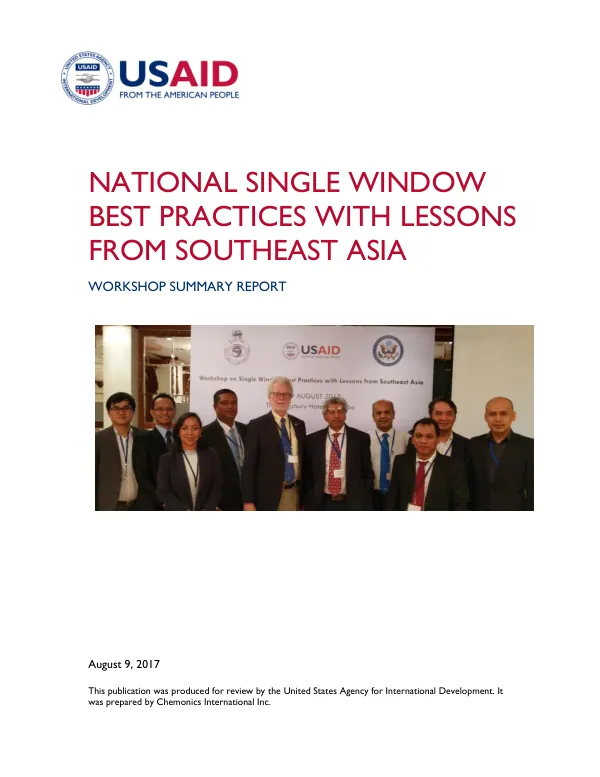
National Single Window Best Practices with Lessons from Southeast Asia
The structure of world trade has dramatically changed over the past two decades.
2017 · 16 pages
Sign in to readA free account is required to download.
Abstract
With the emergence of global value chains, lowering the time and cost of trade transactions is critical to enabling small developing countries such as Sri Lanka to exploit global value chain opportunities that depend on the efficient movement of goods. Many governments worldwide have adopted National Single Window (NSW) initiatives as an instrument to eliminate inefficiency and ineffectiveness in business and government procedures and documentary requirements along the international supply chain, ultimately reducing trade transaction costs and improving border control, compliance, and security. Sri Lanka has undertaken a number of initiatives to improve its trade logistics environment, resulting in performance improvements in some key trade indicators. Sri Lanka's performance on the "Trading across Borders" indicator improved by 16 places in the World Bank's Doing Business 2015 Report, moving from 85 to 69. The time required to import and export has also decreased slightly, though there is scope to improve performance further when viewed against comparators. In the Logistics Performance Index, Sri Lanka has also improved its score slightly on the "efficiency of customs and border clearance" indicator over the same time period. Sri Lanka set up its National Trade Facilitation Committee (NTFC) in June 2014 to meet the requirements of Article 23.2 of the Trade Facilitation Agreement (TFA), to create a mechanism to facilitate both domestic coordination and implementation of the provisions of this Agreement. Although the NTFC has met only a few times, the World Bank trade experts expressed a few concerns in December 2016 about its establishment, mainly the inclusion of an insufficient private sector representation and a lack of clarity in its terms of reference. Sri Lanka Customs recently implemented Automated System for Customs Data (ASYCUDA) World, though without its single-window functionality. Automation projects are underway across various government agencies, including for trade-related functions at regulatory agencies. For instance, the process of handling certificates of origin is being automated at the Department of Commerce (DOC). The World Bank Group (WBG) supported the establishment of the Information Communication Technology Agency (ICTA), which set up the national infrastructure and backbone and middleware infrastructure. The ICTA also created the government's service portal (www.srilanka.lk) and information portal (www.gov.lk). According to the World Bank, Sri Lanka Customs has a number of automation systems apart from ASYCUDA World, including a cargo control system and a remittance management system. Implementation of functional connections to the ASYCUDA World single window have been ongoing; to date, the following have been connected: Customs Brokers, Shipping Agents, and Banks. The USAID Asia and Middle East Economic Growth Best Practices (AMEG) Project identifies, documents, and disseminates best practices in support of sustainable, inclusive economic growth for USAID bureaus and missions in Asia, the Middle East, and North Africa. Through Phase III of its Indo-Pacific Economic Corridor (IPEC) Activity, AMEG carried out a series of activities, interventions, and workshops involving government and private sector stakeholders in South Asia to eliminate non-tariff barriers (NTBs) to trade and promote regional integration. In August 2017, as part of the broader IPEC initiative, AMEG hosted a two-day workshop on NSW best practices for Sri Lankan public and private sector stakeholders to discuss current NSW implementation and lessons learned, identify areas of need in NSW implementation, and capture best practices based on the experience of Association of Southeast Asian Nations (ASEAN) member states. The objective of the event was to facilitate peer-to-peer knowledge exchange between the Government of Sri Lanka and its counterparts in Southeast Asia, share international best practices and lessons learned, and help Sri Lanka develop a single window to facilitate trade with ASEAN. This brief summary report provides background on Sri Lanka's NSW progress, summarizes workshop proceedings, and identifies best practices and opportunities for the Sri Lanka NSW platform. The World Bank will begin assisting the Government of Sri Lanka with its efforts to create a NSW in the fall of 2017.