TETRA-TECH, INC.
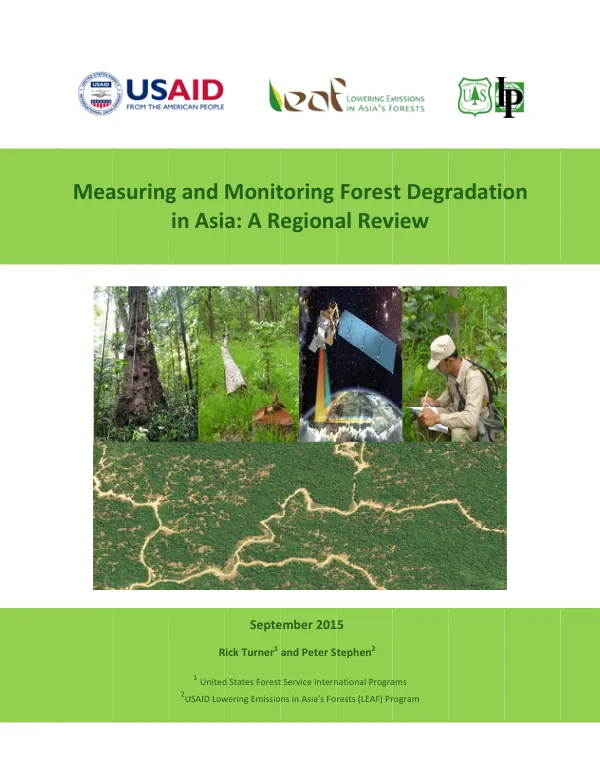
Final Report: Forest Degradation and Emissions in Asia
Forest degradation is a significant issue in Asia, with approximately 100 million hectares of forest disturbed annually, which is nearly 10 times greater than the area impacted by deforestation.
2015 · 37 pages
Sign in to readA free account is required to download.
Abstract
Although methods to detect and monitor deforestation are well-established, there has been increasing interest in developing techniques to measure and monitor forest disturbance and the resulting changes to carbon stocks. USAID and the governments of nine Asian countries are exploring cost-effective national systems for detecting, monitoring, and reporting emissions from forest degradation. The USAID Lowering Emissions in Asia's Forests (USAID LEAF) project aimed to understand how USAID-supported emissions reduction projects are measuring, monitoring, and mitigating greenhouse gas emissions from forest degradation activities. The project also aimed to identify common factors for success and challenges to implementation, as well as recommend actions to support the implementation of forest degradation measurement and monitoring systems. To evaluate the current status of forest degradation monitoring in eight USAID mitigation projects, a framework for analysis was established by developing a standardized questionnaire concerning various aspects of forest degradation monitoring. The questionnaire included questions on forest degradation, emissions estimates, accounting approaches, monitoring methods, data sources, mitigation activities, and monitoring challenges and successes. The aggregate area of the landscapes covered by the eight evaluated projects, located in nine countries, is approximately 24.7 million hectares. The drivers of degradation varied, with selective logging of forests (including legal and illegal logging, either for household and commercial use) being the most common driver across the projects reviewed. Other drivers, such as fuelwood collection, shifting agriculture, grating, and fire, are also present but have a less uniform distribution. Actors or agents responsible for forest degradation activities include commercial activities (both legal and illegal), governments through land management policies that allow or encourage degradation activities, or lack of enforcement of existing law designed to protect forests, and local populations which live in close proximity to forest and are dependent upon it for necessities such as fuel for cooking and lumber for house construction. Of the eight USAID projects evaluated, four (CREL, Forest-PLUS, Hariyo Ban, and B+WISER) are currently implementing a forest degradation monitoring system. A fifth project (USAID LEAF in Lam Dong Province Vietnam) was not evaluated in this report but has recently proposed a forest measuring and monitoring program that encompasses degradation within the Provinces REDD+ Plan. Of these programs, CREL, Hariyo Ban, and B+WISER have just commenced monitoring degradation, and due to insufficient data, no analysis has been completed. The Forest-PLUS program is monitoring only in small demonstration sites located within its project landscapes. While no project is explicitly working on national forest measuring systems, all are supporting technical developments within their respective landscapes. The significance of emissions from forest degradation as a proportion of forest sector emissions varies by landscape. In all four projects, emissions from forest degradation are a significant proportion of total forest sector emissions. The USAID LEAF project in Lam Dong Province Vietnam has proposed variations to Vietnam's National Forest Inventory program to strengthen degradation measuring and monitoring mechanisms. SFB, USAID LEAF/USFS (in PNG and Laos landscapes), and V are in the early stages of investigating a degradation measuring and monitoring system, while IFACS is not planning to monitor forest degradation for their landscapes. The USAID LEAF project has identified several key findings, including the need for cost-effective national systems for detecting, monitoring, and reporting emissions from forest degradation. The project has also identified the importance of understanding the drivers of forest degradation and the need for a standardized framework for analysis. The project has recommended actions to support the implementation of forest degradation measurement and monitoring systems, including the development of a national forest measuring system and the establishment of a regional forest monitoring network. The USAID LEAF project has also identified several challenges to implementation, including the lack of data on forest degradation and the need for technical assistance to support the development of national forest measuring systems. The project has also identified the need for a regional forest monitoring network to support the implementation of forest degradation measurement and monitoring systems.