OPEN SOCIETY INSTITUTE
National Study of Undergraduate Teaching Practices in Palestine
The Palestinian Faculty Development Program (PFDP) has been actively involved in various initiatives to enhance the quality of teaching practices in Palestinian higher education institutions.
2010 · 5 pages
Sign in to readA free account is required to download.
Abstract
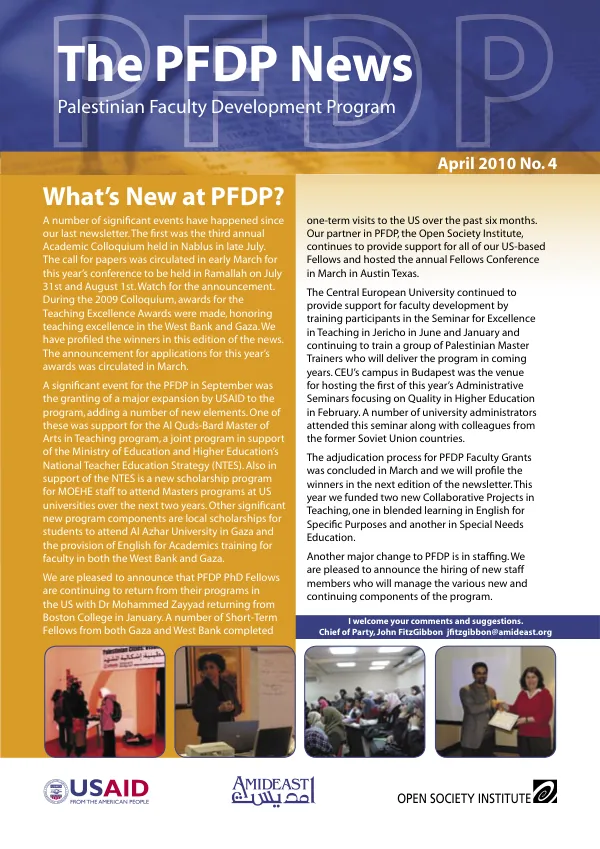
The program's efforts are focused on addressing the challenges faced by Palestinian universities, which include limited access to quality education, inadequate infrastructure, and a lack of resources. A significant event for PFDP in September was the granting of a major expansion by USAID to the program, adding new elements such as support for the Al Quds-Bard Master of Arts in Teaching program and a new scholarship program for Ministry of Education and Higher Education (MOEHE) staff to attend Masters programs at US universities. Additionally, local scholarships for students to attend Al Azhar University in Gaza and English for Academics training for faculty in both the West Bank and Gaza were introduced. The PFDP has also been working to support the development of Palestinian faculty through various initiatives, including the National Study of Undergraduate Teaching Practices in Palestine. The study, led by Dr. Louis Cristillo of Columbia University Teachers College and Dr. Amaney Jamal of Princeton University, aimed to identify the practices and processes that comprise undergraduate teaching in Palestine today. The study found that one of the strongest predictors of excellence in teaching practices is the extent to which new teachers are provided with effective in-service training and professional support during their first year of service. The study also revealed huge discrepancies in the quality of teaching practices across Palestinian universities, with some institutions managing to establish very high-quality teaching practices despite the political and economic instability of the past few decades. However, the study highlighted the need to address structural issues and constraints, including budgetary issues and overcrowded classrooms, as well as the lack of infrastructure to support educational technology and the training of personnel to manage these issues. The PFDP has identified several key areas that need to be addressed to improve the quality of teaching practices in Palestinian higher education institutions. These include the need to prioritize quality of education and teaching, develop a structured program of excellence in teaching, and provide incentives and rewards to motivate teachers to participate in professional development activities. The program also emphasizes the importance of inter-university cooperation, conference seminars, workshops, and mentoring to support the development of Palestinian faculty. The study's findings suggest that faculty and students have high confidence in their institutions to find solutions to their problems, but this confidence is missing in terms of overall political leadership. The Palestinian Authority needs to prioritize higher education as a national issue, recognizing its importance for national security, development, and the future of the Palestinian state. The PFDP has also highlighted the need for sustainability in funding and the importance of cooperation among major institutions, including the Ministry and Council of Higher Education, university presidents, and their respective departments. The program's recommendations include the development of a structured program of excellence in teaching, the provision of incentives and rewards to motivate teachers, and the establishment of a quality assurance unit to monitor and evaluate teaching practices. Overall, the PFDP's efforts aim to address the challenges faced by Palestinian universities and enhance the quality of teaching practices in Palestinian higher education institutions. The program's initiatives focus on supporting the development of Palestinian faculty, improving the quality of teaching practices, and promoting inter-university cooperation and collaboration.