SOCIAL IMPACT, INC.
Nonstate Schools Desk Review Report
Nonstate schooling in the Middle East and North Africa (MENA) region is a complex and multifaceted phenomenon that has been shaped by a variety of historical, cultural, and economic factors.
2021 · 131 pages
Sign in to readA free account is required to download.
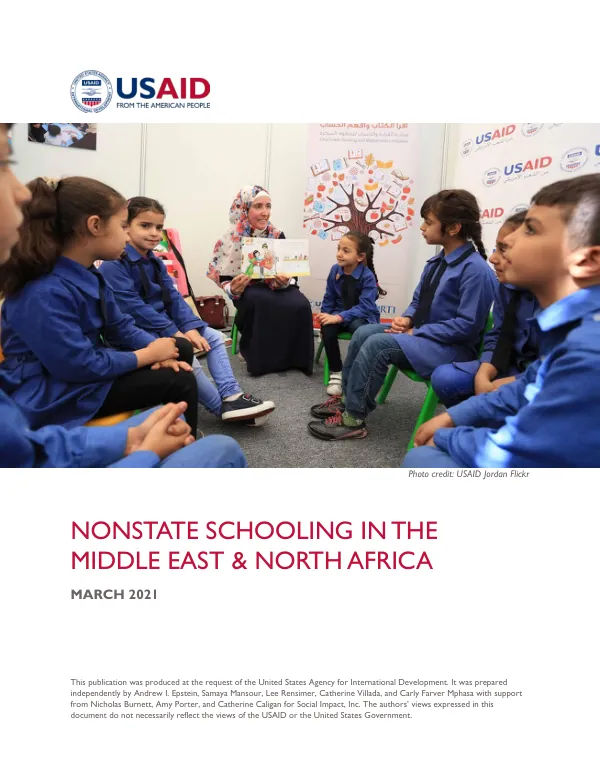
Abstract
The region's educational landscape is dominated by the state, with most schools being state-operated and state-financed. However, there are several unique nonstate schooling models in Egypt, and a growing role for public-private partnership (PPP) and low-cost private models across the region. The study examined the conditions of nonstate schooling at regional and national levels in the MENA region, producing a deeper understanding of the nonstate schooling landscape and building awareness of opportunities and challenges for partnering with nonstate schools in the region. The study team conducted a desk review of existing literature on nonstate schooling in the MENA region, as well as a national data collection phase, where they worked with USAID Missions to contact Education and Statistics officials in the countries under study and requested data from their education management information systems (EMIS) and/or other data sets on nonstate schooling. The study identified several categories of nonstate schools in the region, including religious schools, preschools and kindergartens, and independent or international schools. Religious schools are private schools owned and managed by confessional/religious groups or associations for different Muslim and Christian denominations, with varying funding sources. Preschools and kindergartens are almost exclusively nonstate owned, managed, and financed in most countries studied. Independent or international schools are funded primarily through pupil tuition and are often associated with international curricula and teaching methods. The study found that nonstate schooling is more prevalent in some countries than others, with Egypt, Jordan, and Lebanon having a higher proportion of nonstate schools. The study also found that nonstate schools serve a range of populations, including refugees and internally displaced persons (IDPs). However, the study noted that there are significant gaps in data and knowledge on nonstate schooling in the MENA region, particularly in conflict-affected environments. The study's findings have implications for policymakers and practitioners seeking to improve education outcomes in the MENA region. The study suggests that nonstate schools can play an important role in expanding access to education, particularly for marginalized populations. However, the study also notes that nonstate schools often face significant challenges, including limited resources and inadequate regulation. In terms of policy recommendations, the study suggests that governments in the MENA region should consider partnering with nonstate schools to improve education outcomes, particularly for marginalized populations. The study also recommends that governments should strengthen their regulatory frameworks to ensure that nonstate schools meet minimum standards of quality and equity. Finally, the study recommends that international donors and organizations should provide support to nonstate schools in the MENA region, particularly in conflict-affected environments. Overall, the study provides a comprehensive overview of nonstate schooling in the MENA region, highlighting the complexities and challenges of this phenomenon. The study's findings have important implications for policymakers and practitioners seeking to improve education outcomes in the region.