RTI INTERNATIONAL
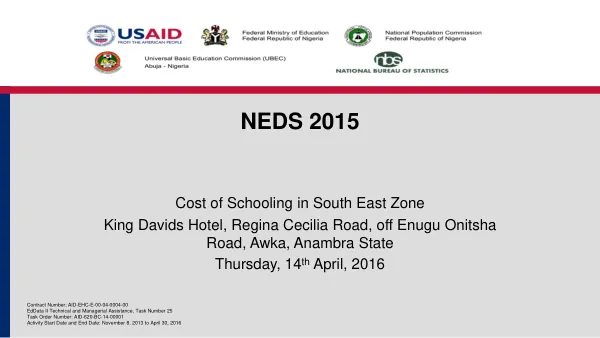
NEDS 2015: Cost of Schooling in South East Zone
The Cost of Schooling in South East Zone report was conducted in 2015 to assess household expenditures on education in the region.
2016 · 15 pages
Sign in to readA free account is required to download.
Abstract
The study focused on the South East Zone of Nigeria, with data collected from various sources, including household surveys and school records. The report provides an overview of per pupil household expenditures on education, broken down by state, school type, wealth quintile, residence, and item-specific expenditures. Per pupil household expenditures on education in 2015 averaged N 12, 111. This amount represents the total expenditures incurred by households for each pupil enrolled in school. The expenditures were categorized into various items, including tuition fees, textbooks, uniforms, and other miscellaneous expenses. The report highlights the significant variation in per pupil household expenditures across different states in the South East Zone, with some states recording higher expenditures than others. The study also examined per pupil household expenditures by school type, revealing that households with children enrolled in private schools incurred significantly higher expenditures compared to those with children in public schools. For instance, households with children in private schools spent an average of N 24, 111 per pupil, while those with children in public schools spent an average of N 6, 111 per pupil. The report attributes this disparity to the differences in tuition fees and other expenses associated with private and public schools. In addition to the overall per pupil household expenditures, the report also analyzed item-specific expenditures, including the most commonly cited expenditures by school type. The results show that households with children in private schools spent significantly more on tuition fees, textbooks, and uniforms compared to those with children in public schools. Conversely, households with children in public schools spent more on miscellaneous expenses, such as transportation and other incidentals. The report highlights the significant disparities in per pupil household expenditures on education across different wealth quintiles, with households in the highest wealth quintile incurring significantly higher expenditures compared to those in the lowest wealth quintile. The study emphasizes the need for policymakers to address these disparities and ensure that all households have access to quality education, regardless of their socio-economic status.
Related documents