RTI INTERNATIONAL
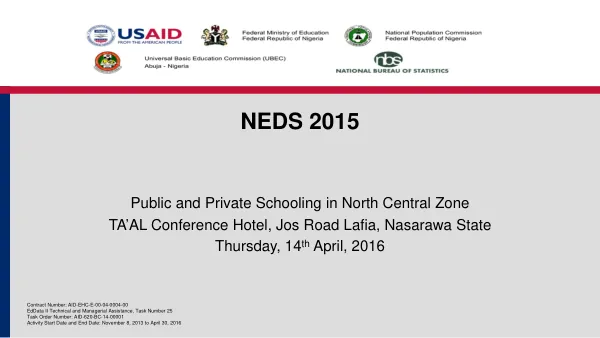
NEDS 2015: Public and Private Schooling in North Central Zone
Public and Private Schooling in North Central Zone is a report focused on the distribution of children by school type in Nigeria.
2016 · 17 pages
Sign in to readA free account is required to download.
Abstract
Nationally, in 2015, the majority of children attended public schools, with 93.4% enrolled in government-owned institutions. In contrast, 6.6% of children attended private schools. The distribution of children by school type varies across zones in Nigeria. In the North Central Zone, 92.1% of children attended public schools, while 7.9% attended private schools. This trend is consistent with national figures, indicating a strong preference for public schooling in this region. However, the distribution of children by school type also varies across states within the North Central Zone. For example, in Nasarawa State, 95.2% of children attended public schools, while in Plateau State, 88.5% attended public schools. Household expenditures on education also play a significant role in determining school choice. Average household expenditure per child by level and school type in 2015 reveals that public school attendance is associated with lower household expenditures. On average, households spent N 12,111 per child in public primary schools, compared to N 24,111 in private primary schools. Similarly, households spent N 18,111 per child in public junior secondary schools, compared to N 30,111 in private junior secondary schools. The distribution of children by school type and residence also provides insights into school choice patterns. In urban areas, 85.6% of children attended public schools, while in rural areas, 95.2% attended public schools. This suggests that households in rural areas may face greater barriers to accessing private schooling, contributing to the higher proportion of public school attendance in these areas.
Related documents