EVALUATION TECHNOLOGIES, INC.
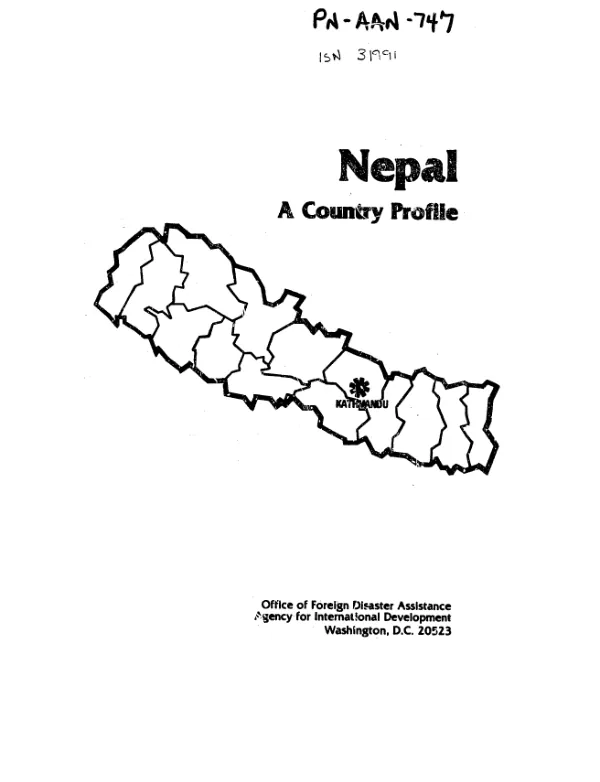
Nepal : a country profile
One-third of Nepal"s forests were cleared in the period 1973-83 and total denudation is forecast by the end of the century.
1983
Sign in to readA free account is required to download.
Abstract
This report assesses the impact of deforestation and other disasters, as well as Nepal"s capacity to defend itself against them. A brief overview of the country"s customs, economy, and politics is followed by a discussion of major hazards. According to the report, deforestation (resulting from clearance for farming, firewood, and fodder) is rapidly destroying Nepal"s delicate mountain environment. Although soil erosion is a natural process in the unstable Himalayas, deforestation doubles the normally expected soil loss, and livestock grazing on the cleared fields exacerbates the problem. Deforestation has also increased Nepal"s vulnerability to landslides and flooding. The accumulation of sand and debris on floodplains raises riverbeds and, as a result, more water and sediment are carried downstream to Nepal"s tropical Tarai region and India"s Bihar state. Additional threats are identified as earthquakes, drought, fires (both natural and man-made), and epidemics (primarily malaria, typhoid, leprosy, filariasis, and syphilis). Final sections assess Nepal"s disaster preparedness, covering host country plans, institutions, warning systems, and resources (i.e., food, medical care, transportation, communications, and energy), as well as A.I.D., international, and voluntary contributions.
Related documents