FHI 360
New PrEP Products for Asia Pacific: What Do We Need to Know?
The World Health Organization (WHO) has recommended oral pre-exposure prophylaxis (PrEP) for people at substantial risk of HIV since 2015.
2021 · 4 pages
Sign in to readA free account is required to download.
Abstract
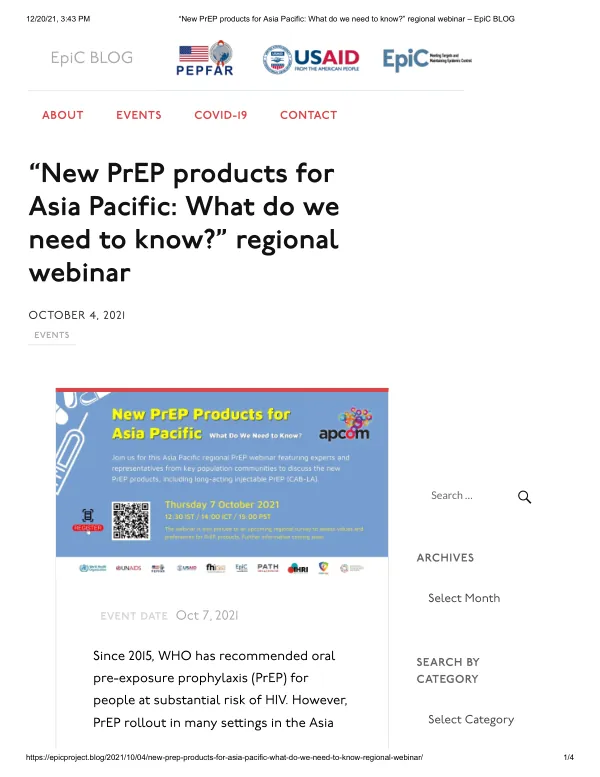
However, PrEP rollout in many settings in the Asia Pacific region is limited and not at scale. This is the time to advocate for PrEP, especially with the availability of new PrEP products. In 2019, WHO updated guidance on oral PrEP to include the option of event-driven PrEP (ED-PrEP, also known as 2+1+1) for cisgender men who have sex with men. In 2021, WHO recommended the dapivirine vaginal ring as an additional PrEP option for cisgender women at substantial risk of HIV. The injectable drug cabotegravir (CAB-LA) has also shown positive results for the prevention of HIV among cisgender men and transgender women who have sex with men. A webinar, organized by APCOM with the support of WHO, UNAIDS, and USAID, along with FHI 360, EpiC, PATH, IHRI, PrEP Viet, and APTN, will focus on new PrEP modalities in the Asia Pacific region. The webinar will discuss the evidence supporting control efforts around the world, including CAB-LA from the successful HPTN 083 study and implications for combination prevention and other future PrEP products. Representatives from key population communities will also share their views on how they envision PrEP use going forward. The webinar, titled "New PrEP Products for Asia Pacific: What Do We Need to Know?", will take place on Thursday, October 7, 2021. Registration is available through the provided link. The webinar aims to provide a platform for discussion and sharing of information on new PrEP products and their potential impact on HIV prevention in the Asia Pacific region.