USAID. BUR. FOR AFRICA. OFC. OF REGIONAL AFFAIRS
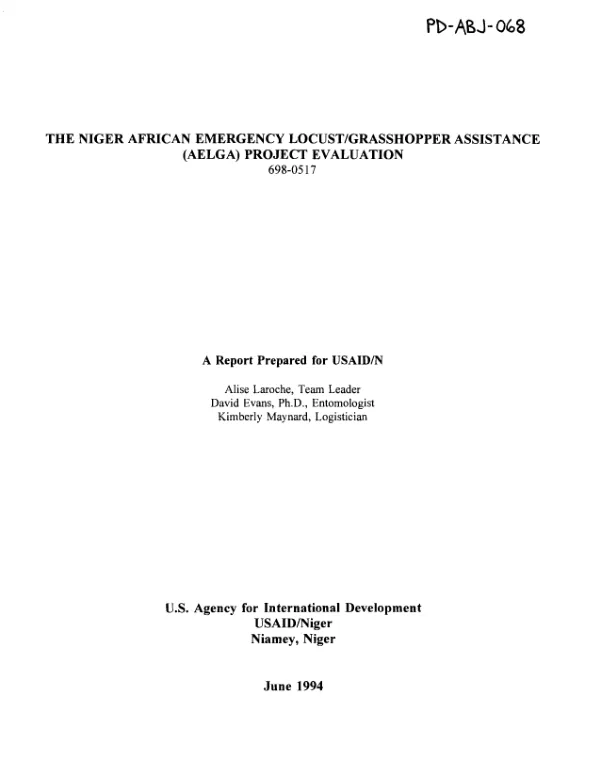
Niger African emergency locust/grasshopper assistance (AELGA) project evaluation
Evaluates the African Emergency Locust/Grasshopper Assistance (AELGA) project.
Laroche, Alise|Evans, David|Maynard, Kimberly · 1994
Sign in to readA free account is required to download.
Abstract
Since the mid-term evaluation in 1989, AELGA, in collaboration with strong efforts from other donors, has made great strides in improving Niger's national capacity to launch effective, organized, and environmentally sound crop protection efforts. Niger's crop protection program has significantly increased its capability to conduct adequate surveys and control in recent years. Approximately 34,600 farmers in village brigades were trained in defense against pest infestations. AELGA funding in the past six years has virtually sustained Niger's aerial survey and control operations. It has also provided the necessary fuel for ground survey and control, essentially built the entire communication network, and contributed to the expertise level through training. Niger's crop protection program is nevertheless losing substantial donor support. It is during this transition to self-sufficiency that USAID should pay specific attention to pest management issues in order to maintain the national capacity and assist in its evolution toward sustainable crop protection. Without USAID support and many other significant efforts, DCP's (Directorate of Crop Protection) capacity to handle pest outbreaks would have been seriously flawed. Given the marginal food production capability in Niger, AELGA assistance is vital to preventing possible famine. AELGA should look for new ways to foster sustainability in Niger's pest management program, specifically, through further development of Niger's unique aerial control capability. This resource should be developed so that Niger could "export" its aerial pest control services to the region. should be continued include initiatives in village brigade training. In order for self-sufficiency to develop, AELGA should initiate efforts to coordinate the efforts the numerous donors and agencies for a more consolidated and sustainable approach. These institutions should conduct regular meetings on pest management issues. One of the most dramatic developments was the removal of all of the unwanted dieldrin from Niger through AELGA's innovative Niger Dieldrin Disposal Project (NDDP). Empty pesticide containers, however, remain as potential risks to human health in Niger, as containers are a valuable commodity in the country primarily for food, water, and fuel storage. USAID/N has begun an approach to the issue of container disposal with last year's draft of a "Prototype Barrel Disposal Plan" for empty organophosphate containers. The draft should be thoroughly reviewed before implementation. The security issue in northern Niger remains an impediment to effective locust control. Desert locust population upsurges in key breeding areas of Niger's remote Air Mountains and the Tamesna can result in massive and highly mobile swarms if left uncontrolled. Early intervention can minimize the threat to Niger as well as to other countries in the Sahel, the Maghreb, and the Horn of Africa. It is imperative that any future pest management system include an environmental impact agenda. Environmental monitoring can identify negative effects on flora and fauna, as well as detect improper application methods which can harm human health and increase operational costs. Locust and grasshopper control involves vigilant surveillance, monitoring, and preventive intervention as well as emergency response. The overriding goal is the complete evolution from emergency intervention during plagues to preventive pest management, and from donor-driven to national and regional self-sufficiency with auspicious, comprehensive, and self-sustaining operations. While USAID (through AELGA) and other donors have made significant progress in developing Niger's crop protection services, the objective of securing a preventive strategy has not yet been attained. Were USAID and the Disaster Preparedness and Mitigation program not to continue support for pest management activities, the achievement of this goal would certainly be precluded. Furthermore, effective pest outbreak intervention capacity will be derailed and the remarkable gains made over the past five years will have been for naught. USAID/N's agenda should include: making pest management a priority within the DPM program's mandate, assisting the DCP in capacity-building, and maintaining inter-agency and regional relationships in crop protection. (Author abstract, modified)