USAID DEC
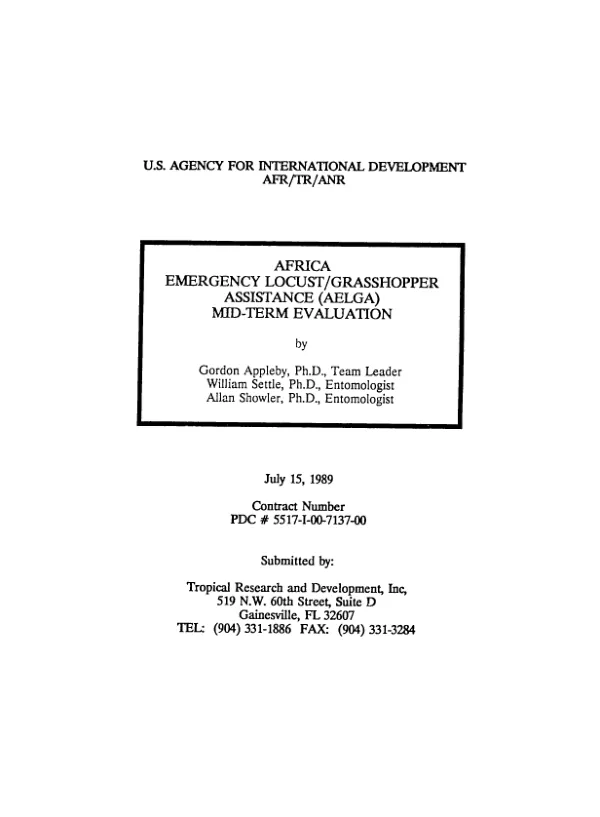
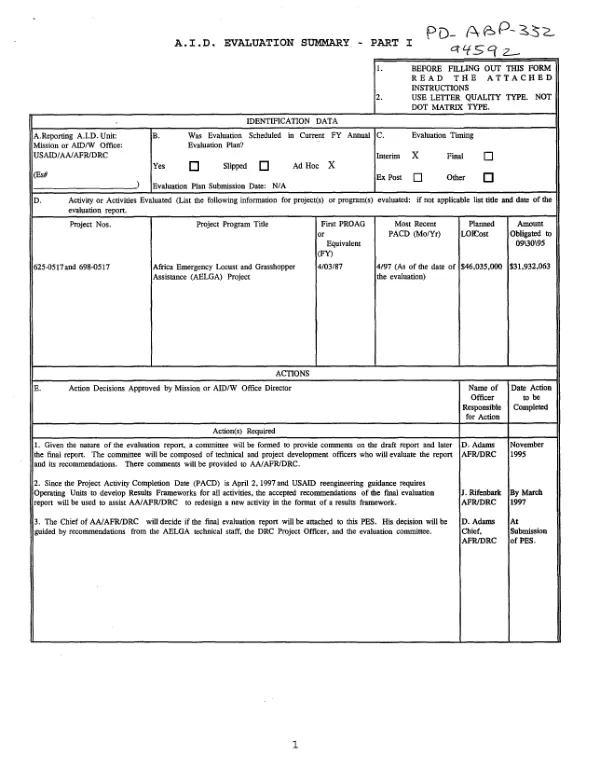
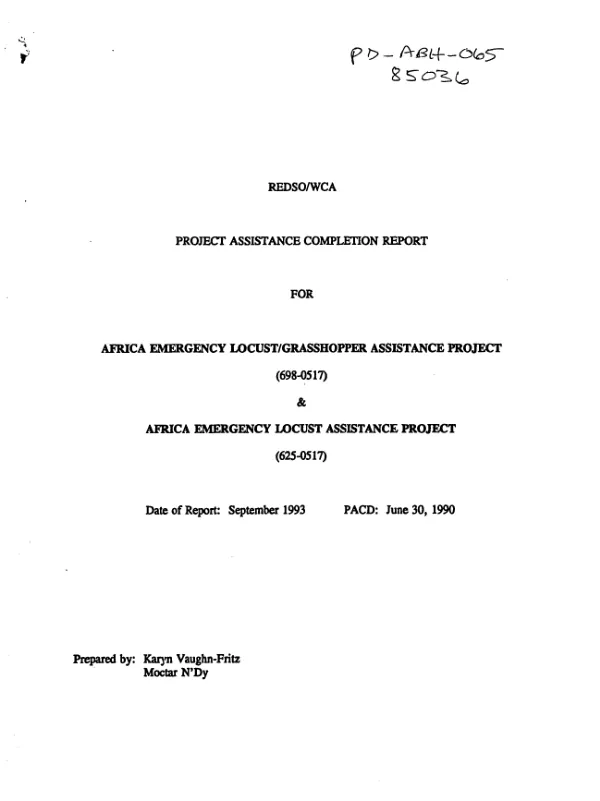
REDSO/WCA project assistance completion report for Africa emergency locust/grasshopper assistance project (698-0517) and Africa emergency locust assistance project (625-0517)
Sign inUSAID. BUR. FOR AFRICA. OFC. OF REGIONAL AFFAIRS
REDSO/WCA project assistance completion report for Africa emergency locust/grasshopper assistance project (698-0517) and Africa emergency locust assistance project (625-0517)
PACR of Mauritania activities of two regional projects to implement emergency locust/grasshopper control measures and related disaster relief and institution-building efforts: the Africa Emergency Locust/Grasshopper Assistance Project (AELGA, 6980517, implemented 3/88-6/90) and the Africa Emergency Locust project (6250517, implemented 6/87-6/88 and then combined with AELGA).
Vaughn-Fritz, Karyn|N'Dy, Moctar · 1993
Sign in to readA free account is required to download.
Abstract
In Mauritania, the projects focused on providing TA, short-term operational training, commodities, and institutional support for aerial and ground survey and control activities. The primary planned output, to assist the Mauritanian National Crop Protection Service (CPS) in rapidly suppressing crop-destroying grasshoppers and locusts, was accomplished. During 1988, over 900,000 ha were treated with powder and/or liquid pesticides, and the CPS reported in 3/89 that sorghum, corn, and vegetable crops were out of danger and maturing favorably. The projects also assisted CPS in planning for future grasshopper and locust outbreaks. The program's success was attributed to the combined efforts of many actors, including the Mauritanian military in treatment and survey activities, and Peace Corps volunteers in survey operations. Using data from the survey activities, technicians were able to detect high-risk infestation areas and mobilize vehicles based in Adrar, Assaba, Brakna, Gorgol, Guidimakha, Hodh Charghi, Hodh Gharbi, Inchiri, Nouakchott, Tagrant, Tiris, Trarza, and Zemmour. Project documentation noted the correlation between drought and pest cycles in Africa. Although the earlier drought had hurt Mauritania's economy, it had also kept grasshoppers and locusts in check, while the return of rains brought with them the threat of pest-induced famine. The onset of unfavorable breeding conditions was therefore also a factor in bringing the plague under control. Despite its success, the program experienced setbacks due to the ethnic-based civil strife in Mauritania; firing and forced expulsions of government employees of Senegalese descent disrupted the implementing institutions -- the Ministry of Rural Development, Department of Agriculture, and the CPS. However, the vacancies were eventually filled. In the absence of project reviews or evaluations, lessons learned could not be ascertained.
Related documents
Documents in this collection
 1993
1993USAID DEC
REDSO/WCA project assistance completion report for Africa emergency locust/grasshopper assistance project (698-0517) and Africa emergency locust assistance project (625-0517)
Open record 1993
1993USAID DEC