USAID DEC
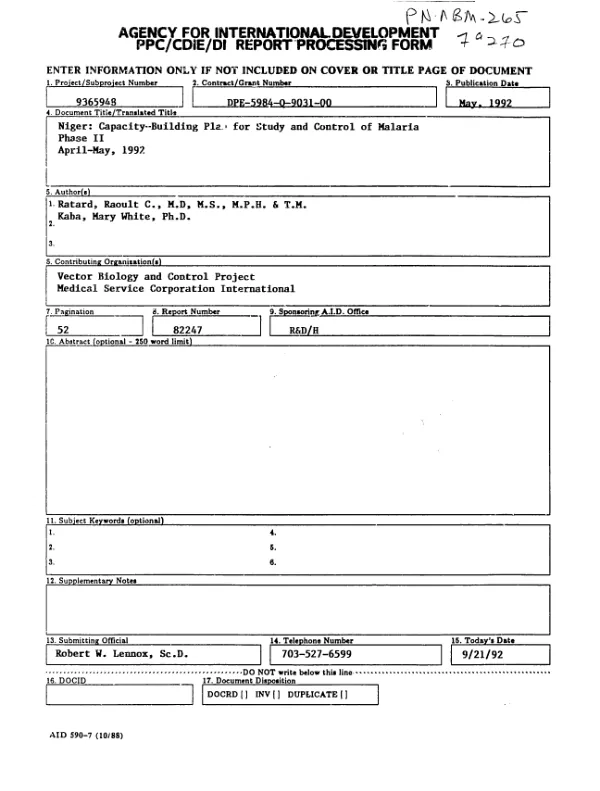
Niger : capacity-building plan for study and control of malaria, phase II, April-May 1992
Sign inMEDICAL SERVICE CORP. INTERNATIONAL
Niger : capacity-building plan for study and control of malaria, phase II, April-May 1992
The Ministry of Public Health (MOPH) of Niger requested the assistance of USAID to study malaria: its transmission, impact on health, management by the health services, and the knowledge, attitudes, and practices of the population regarding the disease.
Ratard, Raoult C.; Kaba, Mary White · 1992
Sign in to readA free account is required to download.
Abstract
This study was conducted during the dry season, and followed a preliminary study carried out during the rainy season, September- October, 1991. Parasitologic surveys showed important differences in the epidemiology of malaria in different villages within the same area, and from season to season. Although there was a sharp decrease in malaria incidence from the rainy to the dry season, there were still a fair number of infections during the dry season. A thorough knowledge of the epidemiology is necessary to guide the clinician in the management of malaria and fever. The distribution and prevalence of Anopheles is very different during the dry season than during the rainy season. During the dry season, there are large areas where there are no suitable breeding places suitable for Anopheles -- for example, in the villages of the Sahelian or Saharan zones, which have no surface bodies of water a few months after the end of the rainy season. Some heavily polluted permanent surface waters are no longer suitable for Anopheles during the dry season, allowing only culicine breeding. Along the Niger river, suitable breeding sites can be found during the dry season, although Anopheles densities are lower than those observed during the rainy season. In spite of the very low levels of education and literacy of the majority of the population, there was a fair level of knowledge about malaria, its transmission, and its treatment (practically all rural residents had suffered from malaria). The role of mosquitoes, the significance of the rainy season, and treatment with chloroquine were fairly well known. Educated individuals have a better understanding of malaria; this knowledge seems to have led to a lower mortality rate among children of educated women. A high proportion of the population attributed diseases to natural causes; magic and religion were less often invoked as causal factors. Thus a health education campaign probably would be fairly well accepted. Medical services, dispensaries, village health workers, and medical centers were well accepted by the population. They are well used when available. Distance and lack of supplies are the main impediments to their extended use. The most important conclusions of the epi-clinical studies were: (1) practitioners are fairly proficient at diagnosing malaria; (2) a correct diagnosis does not mean the correct treatment will be recommended; (3) chloroquine is prescribed in insufficient doses; (4) injectable quinine is overused; (5) duration of treatment is too short; and (6) practitioners are not taking the time necessary to motivate patients to comply fully with the prescriptions. The study confirmed that personnel from the MOPH are capable of carrying out multidisciplinary studies including parasitology, entomology, and sociology. The parasitologists, entomologists, and sociologists have adequate technical skills. The Nigerien personnel carried out the surveys. The computer system in place at the National Information System (SNIS) is perfectly adequate for handling and analysis of the data collected. Supplemental studies could easily be carried out at affordable costs if study sites were not too far from Niamey. In a later stage, they could be carried out in more remote areas after proper training of the health personnel from those areas. (Author abstract)