MEDICAL SERVICE CORP. INTERNATIONAL
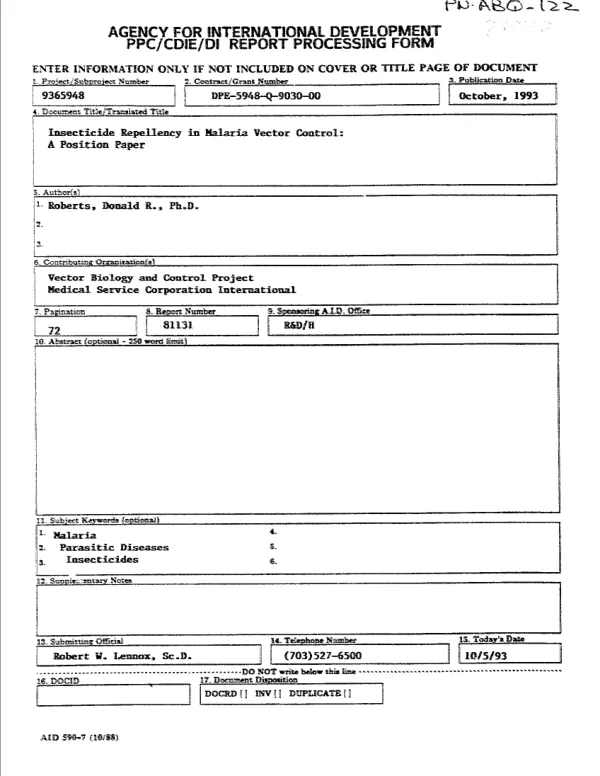
Insecticide repellency in malaria vector control : a position paper
Even today the primary method of protecting humans from malaria-carrying Anopheles mosquitoes is through application of insecticide residues, primarily DDT, to house walls.
Roberts, Donald R. · 1993
Sign in to readA free account is required to download.
Abstract
The concept behind this method is that malaria vectors enter houses to feed on humans, land on sprayed walls, and eventually succumb to the insecticide. The results of many field studies, however, show that the primary insecticidal effect is behavioral avoidance of the chemical. DDT keeps some important mosquitoes out of the house. There is currently no good testing mechanism for looking at vector behavior, yet as this paper indicates, avoidance behaviors serve to reduce human-vector contact. Regrettably, this effect with DDT was not fully analyzed when the insecticide was first used in malaria eradication programs. In deciding which chemicals to use for malaria control, decisions were historically made on the basis of physiological susceptibility of vectors to insecticides. If the primary chemical action is repellency that prevents vectors from entering houses or from biting once they are inside, then physiological susceptibility, unfortunately, is only of secondary importance. There are many possible outcomes of an induced behavioral avoidance response in malaria vectors to insecticides. At one end of the spectrum is a powerful repellent action that prevents the mosquito from entering an insecticide-sprayed house. Because most cases of malaria are acquired inside of houses, the repellent action will produce a strong reduction in human-vector contact and malaria transmission. This level of repellency has been documented for populations of Anopheles darlingi along the Ituxi River in the Amazon Basin. More moderate levels of behavioral avoidance have been documented for other vector species. Based on detailed African field studies described in this paper, as many as 70% of the house-entering An. gambiae females were repelled by DDT-sprayed houses. Using field observations to define an outcome for a hypothetical cohort of 1,000 house-entering An. gambiae mosquitoes, only 300 would enter the sprayed house. Once inside the sprayed house, 192 would successfully take a blood meal. Of these, only 146 would exit the house and be alive at sunrise. In comparison, 792 blood-fed females would exit an unsprayed house and be alive at sunrise. In this example, the overall impact of DDT-sprayed walls was expressed through behavioral avoidance. Only 46 blood-fed females would actually die from insecticide exposure. In total, the behavioral responses alone accounted for a 76% reduction in indoor malaria transmission potential. The behavioral responses of vectors to synthetic pyrethroids are discussed in an attempt to learn from the experience with DDT and focus attention on the need for studying behavioral responses of vectors to pyrethroids before wide-scale use of these chemicals in malaria control. This is particularly important given the interest in insecticide treated mosquito netting as a powerful tool to fight malaria. The author emphasizes here that there were considerable benefits for malaria control from DDT spraying. Because of this insecticide"s effectiveness, Mexico and India have gone back to using DDT for malaria control in some areas. However, negative press and prejudice against long-acting insecticides, as well as insecticide resistance issues, will eventually stop the use of DDT for public health. New, generally more expensive insecticides will be used, and some may have behavioral effects. Unfortunately, there is no good test to determine these effects and whether or not they significantly reduce human-vector contact. There is a need to develop such a test. (Author abstract)
Related documents