ABT ASSOCIATES, INC.
Niger : rice and cotton policy
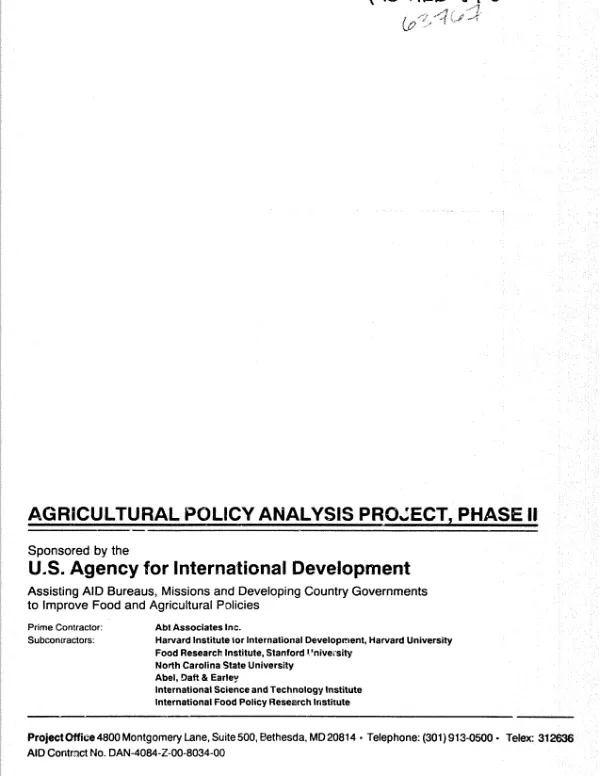
This study, conducted for USAID/Niamey under Phase II of the Agricultural Policy Analysis Project (APAP II), analyzes efficiency of resource allocation in the rice and cotton sectors in Niger.
Rassas, Bechir; Loutte, Thierry · 1989
Sign in to readA free account is required to download.
Abstract
Nominal protection coefficients indicate that domestic prices of the two commodities have been above border prices. Effective protection coefficients are, in general, higher than the nominal protection coefficients, reflecting the subsidies accorded to farmers of certain inputs such as seed and insecticides. Net returns, defined as gross revenue minus all fixed and variable costs, including family labor valued at market wages, average cfa 120,000/ha per year for rice and are positive in most years for cotton. However, when output and all inputs are valued at their opportunity cost, net returns become negative for both crops. Factors contributing to this shift include the input subsidy and the discrepancy between domestic and border prices. Welfare analysis shows that present policies in the rice and cotton sectors reduce national income, for income gains to producers and the government are more than offset by income losses to consumers who, as a result of the import tariff and other taxes, pay higher prices for both locally produced and imported rice. Similarly, income gains to cotton growers are more than offset by income losses to the government from the producer subsidy. (Author abstract)
Related documents
![Baseline of APRP [agricultural policy reform program] progress indicators, 1990-1997](https://covers.devme.ai/gen/26974.webp)
![Intermediate effects of policy reform under APRP [agricultural policy reform program] : progress indicators, 1990-2001](https://covers.devme.ai/gen/44052.webp)