USAID. MISSION TO NIGER
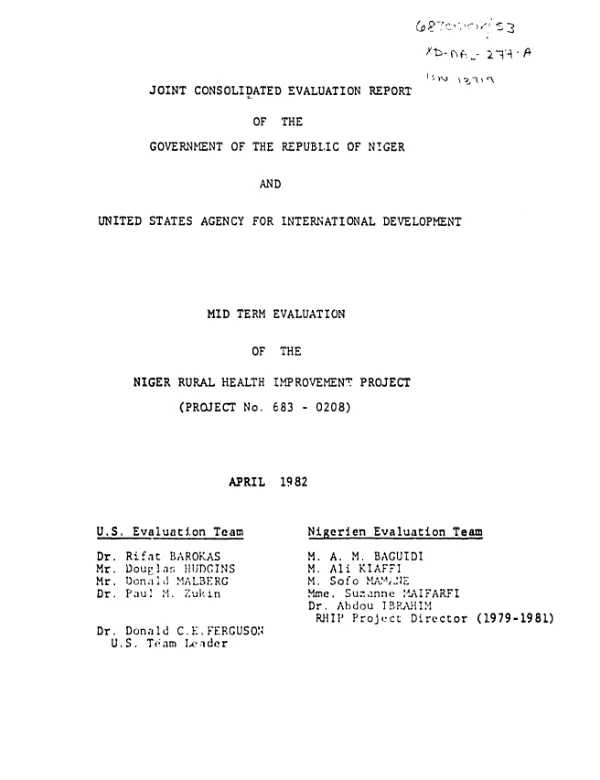
Niger rural health improvement; mid-term evaluation
Evaluates the Niger Rural Health Improvement Project.
Ferguson, Donald C.|Ibrahim, Abdou · 1982
Sign in to readA free account is required to download.
Abstract
Special evaluation covers the period 6/78-3/81 and is based on document review, site visits, and interviews with project, USAID/N, and Government of Niger (GON) officials. The project is developing and expanding Niger's rural health system as planned and increased coverage of the rural population by village health teams is largely on target. However, if expansion of the village health team network increases faster than does the number of supervisory staff, major resupply problems will result. In-country training is generally on schedule; 1,235 secouristes (41% of target) and 926 matrones (31% of target) have been trained. Construction of seven new dispensaries and 2 departmental centers is proceeding, but risks becoming a failure due to faulty construction of buildings and foundations and badly conceived water supply and sanitation facilities. The major constraints on the project have been the low level of literacy and education among the rural population, and limited financial and human resources. The present project time frame unfortunately does not take these constraints into account. It is strongly recommended that the project be extended by up to 24 months. A total of 66 other recommendations, varying in priority and importance, are made in regard to the following areas: (1) the project's organizational placement within the Ministry of Health (MOH) and the contractual and organizational relationship of the AFRICARE project to the MOH; (2) changes in policies and practices with respect to specific health services and practices, e.g., malaria control, the Expanded Program of Immunization, treatment of diarrheal diseases, and sterilization of needles and syringes; (3) specific changes in rural water supply and sanitation activities; (4) major improvements in the MOH's health planning and statistics capabilities; (5) administrative and management arrangements for health facility construction and renovation; (6) improvements in development and logistic support activities at all levels; and (7) increases in the scope and pace of already programmed training activities. Following each recommendation are GON comments on it and USAID/N responses to the recommendation and/or the comments.