RTI INTERNATIONAL
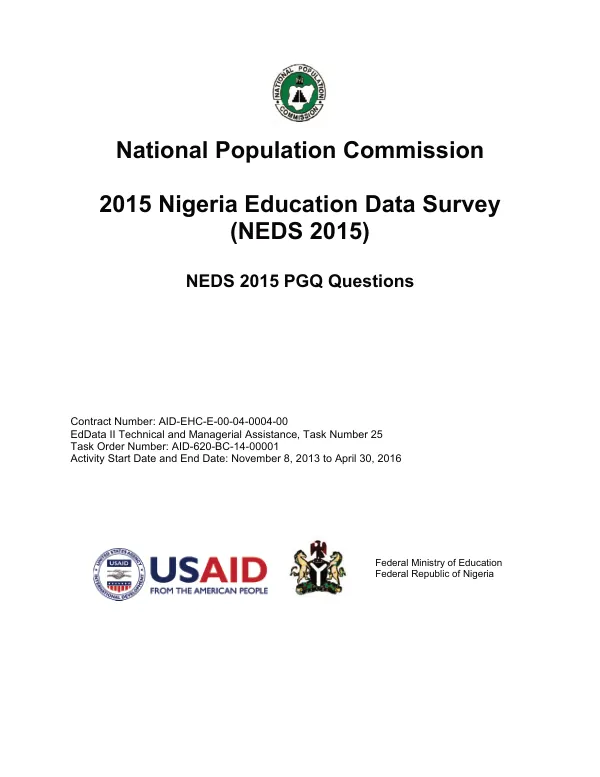
Nigeria Education Data Survey (NEDS 2015)
The 2015 Nigeria Education Data Survey (NEDS 2015) was conducted by the National Population Commission in collaboration with the Federal Ministry of Education.
2015 · 25 pages
Sign in to readA free account is required to download.
Abstract
The survey aimed to collect data on the education sector in Nigeria, focusing on the availability and quality of education services, as well as the financial resources allocated to education. The survey collected data on various aspects of education, including the number of schools, teachers, and students, as well as the availability of educational materials and infrastructure. The data also included information on the household expenditure on education, including tuition fees, school development levies, and examination fees. One of the key findings of the survey was that the majority of households in Nigeria spent a significant amount of money on education, with an average expenditure of Naira 10,000 per child per year. The survey also found that the majority of households relied on private schools, with 70% of households reporting that their children attended private schools. The survey also collected data on the availability of educational materials, including textbooks, pens, pencils, and exercise books. The data showed that the majority of households reported that their children received free educational materials, with 80% of households reporting that their children received free textbooks. The survey also collected data on the household expenditure on school uniforms, school clothes, and school clothes bought for children. The data showed that the majority of households spent an average of Naira 5,000 per child per year on school uniforms, school clothes, and school clothes. The survey also collected data on the household expenditure on school bags, with 60% of households reporting that they spent an average of Naira 2,000 per child per year on school bags. The data also showed that the majority of households spent an average of Naira 1,000 per child per year on pens, pencils, and crayons. The survey's findings have implications for education policy in Nigeria, highlighting the need for increased investment in education infrastructure, teacher training, and educational materials. The survey's data can also inform the development of education programs and policies that address the needs of households and children in Nigeria. The survey's methodology involved the use of a questionnaire to collect data from households in Nigeria. The questionnaire was designed to collect data on various aspects of education, including the number of schools, teachers, and students, as well as the availability of educational materials and infrastructure. The survey's data was analyzed using statistical software to produce descriptive statistics and frequencies. The data was also used to identify trends and patterns in household expenditure on education. The survey's data can also be used to inform the development of education programs and policies that address the needs of households and children in Nigeria. The survey's findings can also be used to identify areas where education programs and policies can be improved. The survey's data can also be used to inform the development of education programs and policies that address the needs of households and children in
Related documents