USAID DEC
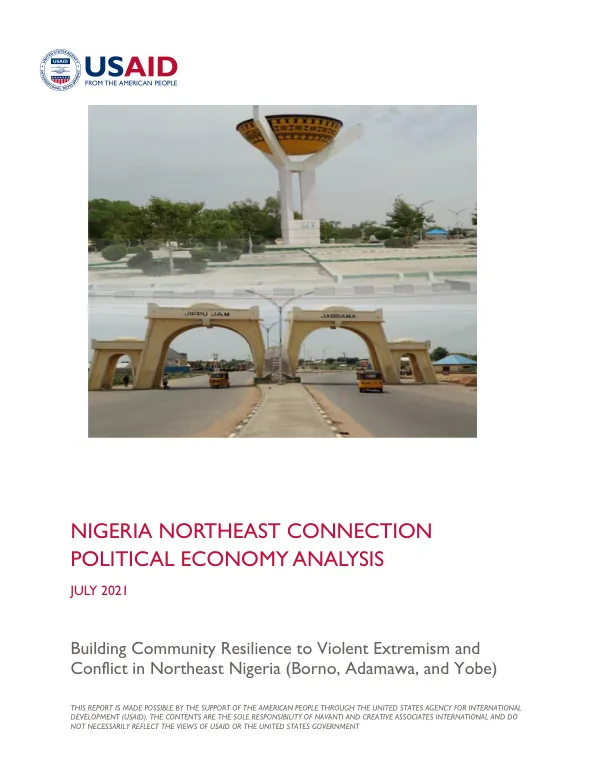
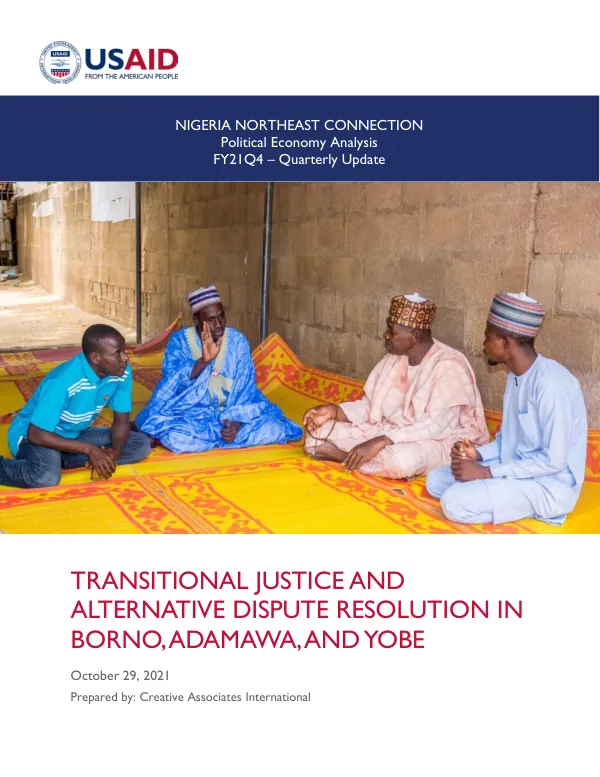
Nigeria Northeast Connection Political Economy Analysis FY21Q4 – Quarterly Update TRANSITIONAL JUSTICE AND ALTERNATIVE DISPUTE RESOLUTION IN BORNO, ADAMAWA, AND YOBE
Sign inCREATIVE ASSOCIATES INTERNATIONAL INC.
Nigeria Northeast Connection Political Economy Analysis FY21Q4 – Quarterly Update TRANSITIONAL JUSTICE AND ALTERNATIVE DISPUTE RESOLUTION IN BORNO, ADAMAWA, AND YOBE
The Nigerian Military has conducted sustained land and aerial bombardment of violent extremist organizations (VEOs) in Borno, Adamawa, and Yobe (BAY) states over the past decade.
2021 · 33 pages
Sign in to readA free account is required to download.
Abstract
However, these efforts have not led to the defeat of VEO groups. The resulting insecurity in the region has had severe negative impacts on the delivery of justice, including systemic abuse and massive human rights violations. As a result, the prevalence of gaps in transitional justice has become apparent. The USAID Nigeria Northeast Connection program has dedicated its quarterly Political Economy Analysis (PEA) to exploring transitional justice and alternative dispute resolution (ADR) mechanisms in the BAY states. The PEA was conducted in seven local government areas (LGAs) of Borno, Adamawa, and Yobe states. Desk research and secondary data sources included academic articles, journals, government literature and reports, and NGO source materials. Respondents to the study included state and local government officials, traditional authorities, community and religious leaders, NGO activists, security actors, survivors/victims of insurgency, and members of marginalized communities. The diversity of these respondents provided a variety of robust viewpoints. Primary data was collected across the study LGAs through 95 key informant interviews (KIIs), 15 focus group discussions (FGDs), and 374 surveys with relevant stakeholders and institutions across the LGAs. The PEA examined legal frameworks, policies, strategies, and challenges of transitional justice and ADR mechanisms in the BAY states. It also assessed the effectiveness of these mechanisms in addressing the root causes of conflict and promoting peace and stability in the region. The PEA found that the current transitional justice and ADR mechanisms in the BAY states are inadequate to address the complex and deeply entrenched issues of conflict and insecurity in the region. The mechanisms are often fragmented, ineffective, and lack the necessary resources and capacity to address the root causes of conflict. The study also found that the prevalence of insecurity in the region has led to a breakdown in the rule of law, with many communities relying on traditional justice systems and vigilante groups to resolve disputes. The PEA identified several key challenges to the effective implementation of transitional justice and ADR mechanisms in the BAY states. These include the lack of a clear and comprehensive legal framework, inadequate resources and capacity, and the prevalence of insecurity and violence in the region. The study also highlighted the importance of addressing the root causes of conflict, including poverty, inequality, and social exclusion, in order to promote peace and stability in the region. The PEA made several recommendations for the effective implementation of transitional justice and ADR mechanisms in the BAY states. These include the development of a clear and comprehensive legal framework, the provision of adequate resources and capacity, and the establishment of a robust and inclusive justice system that addresses the needs and concerns of all stakeholders. The study also recommended the establishment of a national dialogue and reconciliation process to address the root causes of conflict and promote peace and stability in the region.
Related documents