USAID DEC
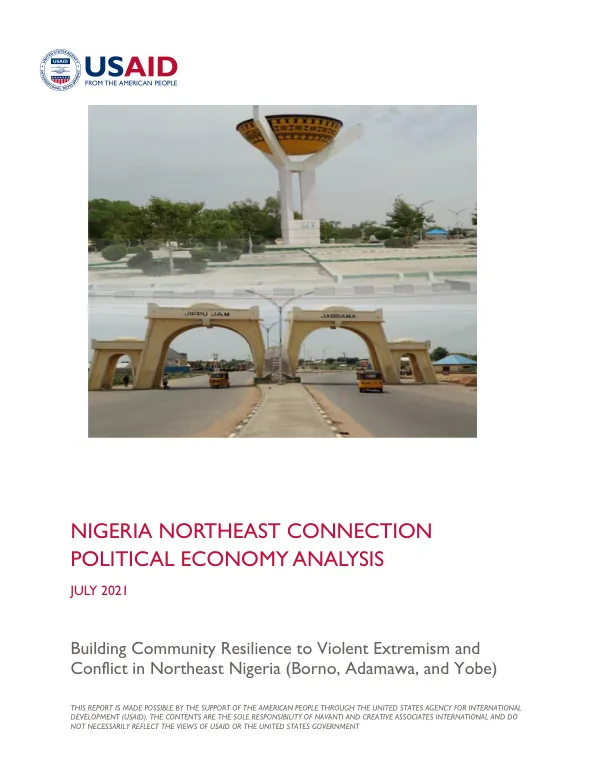
Nigeria Northeast Connection: Building Community Resilience to Violent Extremism and Conflict in Northeast Nigeria
Sign inCREATIVE ASSOCIATES INTERNATIONAL INC.
Nigeria Northeast Connection: Building Community Resilience to Violent Extremism and Conflict in Northeast Nigeria
The Northeast Connection: Building Community Resilience to Violent Extremism and Conflict in Northeast Nigeria project aims to strengthen the resilience of communities vulnerable to violent extremist infiltration and conflict.
2021 · 49 pages
Sign in to readA free account is required to download.
Abstract
Specifically, it focuses on communities on the periphery, where violence is a threat, but where Violent Extremist Organization (VEO) activity and influence are not dominant. The states of northeast Nigeria represent a complex mix of ethnic and religious diversity, where formal and informal structures shape resilience and marginalization at the local level. The national government's neglect, followed by a strong focus on security-driven response which did not address the root causes of violence and extremism, has contributed to an environment where VEOs have had freedom to operate and build influence. State and local level political actors have a history of using ethnic and religious differences to divide populations and corruption has been a persistent problem. Given the prevalence of agriculture in the target states (Adamawa, Borno, and Yobe), conflict between herders and farmers adds an additional layer of complexity to the promotion of community resilience. The Political Economy Analysis (PEA) was conducted in fifteen local government areas (LGA) in three states in northeast Nigeria: Adamawa state (Guyuk, Demsa, Numan, Lamurde, Mubi South and Mubi North), Borno state (Kwaya Kusar, Hawul, Shani, Maiduguri, Biu, Jere) and Yobe state (Gujba, Potiskum, Damaturu). Existing literature was selected from academic, government, and NGO sources, and was categorized by violence, governance, resilience, and response in northeast Nigeria. Study respondents were purposively drawn from a list approved by the NE Connection team, which included local government officials, traditional and religious leaders, NGO-activists, and members of marginalized communities. Primary data was collected in all 15 target LGAs. Key informant interviews (KIIs), focus group discussions (FGDs), and small-scale surveys were used to generate primary data for the study. A total of 126 KIIs and 15 FGDs were conducted with relevant stakeholders/actors and institutions across the 15 LGAs. Small scale surveys (200 across 15 LGAs) were also utilized to elicit responses on social cohesion from pre-defined target demographics. Structured interview guides and FGD facilitation guides/closed-question (Likert-scale) surveys were used as instruments for data collection. The PEA provides information to identify and understand the relevant local actors, power structures and dynamics, potential partners and networks, and opportunities associated with supporting community resilience in the selected LGAs throughout Borno, Adamawa, and Yobe states. Utilizing the PEA framework (Foundational Elements, Rules of the Game, Here and Now, Dynamics and Complexity), this study seeks to understand how VEOs impact resilience at the community level. It is designed to identify critical local actors (individuals, groups, and institutions) willing to participate in dialogue, local planning, service learning, economic development activities, research, and early warning and response efforts, with a particular focus on those working with youth, women, internally displaced persons (IDPs), and other marginalized groups. Respondents expressed the need for effective and sustainable strategies when planning and designing resilience interventions across the target locations. They spoke of the need for "tangible" results, which for the most part meant increasing economic opportunities, especially when discussing reducing the vulnerability of youth to VEO recruitment. Respondents across the different data collection modalities (KIIs, FGDs, and small-scale surveys) emphasized the importance of addressing the root causes of violence and extremism, rather than just focusing on security responses. They also highlighted the need for community-led initiatives and the importance of building trust between local communities and government institutions. The study identifies key local actors, including traditional leaders, community-based organizations, and NGOs, who are willing to participate in dialogue and local planning efforts. It also highlights the importance of addressing the needs of marginalized groups, such as youth, women, and IDPs, in order to build community resilience. The study recommends that resilience interventions should focus on addressing the root causes of violence and extremism, rather than just focusing on security responses. It also emphasizes the need for community-led initiatives and the importance of building trust between local communities and government institutions.