USAID. MISSION TO EL SALVADOR
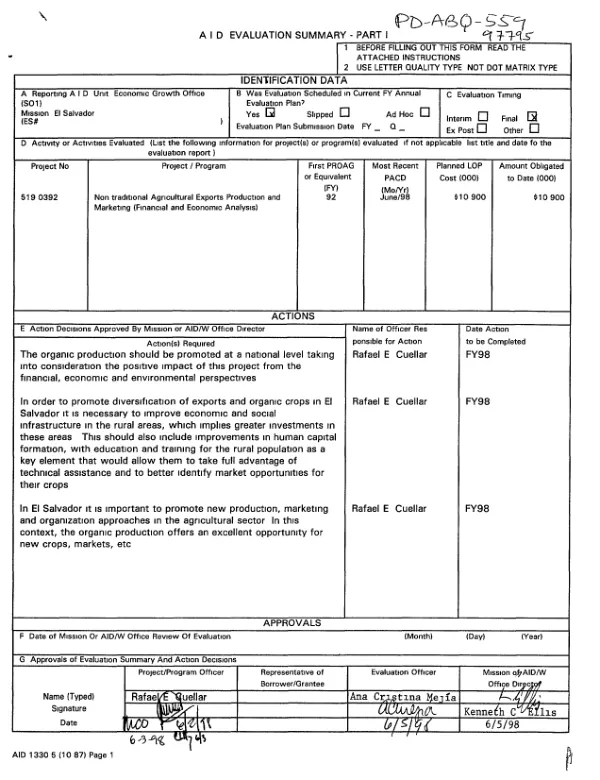
Non-traditional agricultural exports production and marketing
Summarizes final evaluation of a project (1992-6/98) to promote the production and marketing of nontraditional agricultural exports (NTAEs) in El Salvador.
1998
Sign in to readA free account is required to download.

Abstract
The project was implemented by the Cooperative League of the USA (CLUSA). Over its life, the project expanded its concern to nontraditional agricultural (NTA) products in general, as well as to organically grown NTAEs. The first change was due to a strong domestic market for crops traditionally imported, while the latter stemmed from the booming demand for organically produced products in North America, Europe, and Japan. The project has had a significant economic impact on employment generation, production, net earnings, and area planted. It also notably improved the administrative capacities of assisted cooperatives, though much more institutional and organizational development is needed, especially at the primary level. While many participating secondary organizations have become reasonably sustainable, the situation is less certain with many primary level organizations, especially PROEXSAL, which is critical to the survival of many of the others. Good leadership, including the ability to hire a manager, along with the type of land tenure, are key factors in organizational sustainability. CLUSA should focus its remaining efforts on making PROEXSAL and its members sustainable, including making its management structure as efficient and cost-effective as possible. The project has had a recognized impact on environmental issues, including the reduced and more rational use of synthetic agro-chemicals (and the promotion of related government policies), the use of agricultural byproducts that pollute the environment, and the adoption of various soil conservation techniques. There is also circumstantial evidence that the project has raised public awareness of the dangers of chemical-based agriculture and the benefits of organically produced and "environmentally friendly" agricultural commodities. However, much more effort is needed in this area. While soil and compost testing has been performed in many cases, it has not been done in a consistent manner, nor has it been done over time to monitor the effects of soil amendments. Future efforts should begin with extensive soil and soil amendment testing to determine nutrient levels and soil and amendment pH. These levels should also be monitored on a regular basis. Women have benefitted significantly from project emphasis on NTAEs and NTAs in terms of employment generated, training received, and, to a lesser extent, the assumption of leadership roles. Women received 20% of the jobs created by the project and 12% of the training; in the past, the indicators for women in these areas were close to zero. Future projects should include mechanisms that address the role of women and their participation in primary and secondary organizations, and should include one or more trained female technicians on their staff, especially those trained in basic education techniques. Such technicians might significantly improve the impact of TA on women. While much more synergy most likely took place during project implementation than was anticipated, there was virtually no coordination with the Mission"s Equitable Rural Economic Growth (CRECER) project or with the Mission"s environmental projects. Given the growing demand and reduced production costs for organically produced NTAEs, it is clear that one of the best strategies to help the country"s rural poor is to continue with CLUSA"s methodology of producing organic NTAEs and NTAs. This project should be continued both in El Salvador and elsewhere. Lessons learned are as follows: (1) Every project design must allow for changes in project environment. (2) "Mistica" -- a combination of dedication and charisma -- is a key element of project success, as is CLUSA"s role as an independent PVO working with other organizations, both public and private. (3) If an external change agent is given the flexibility, has the "mistica", and works outside of normal bureaucratic channels, he or she can often gain the trust and confidence of both those being assisted and the project"s power brokers.