USAID DEC
Project assistance completion report of the "non-traditional agricultural export, production and marketing project", no. 519-0392
Sign inUSAID. MISSION TO EL SALVADOR
Project assistance completion report of the "non-traditional agricultural export, production and marketing project", no. 519-0392
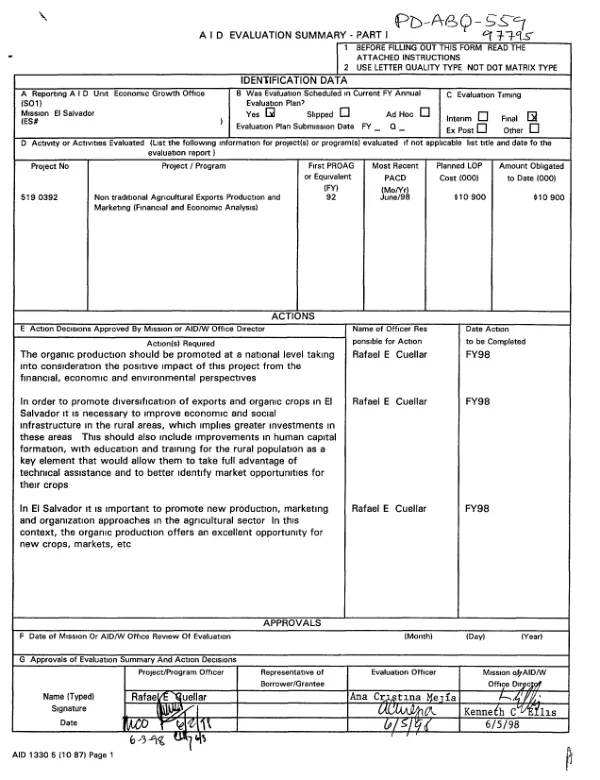
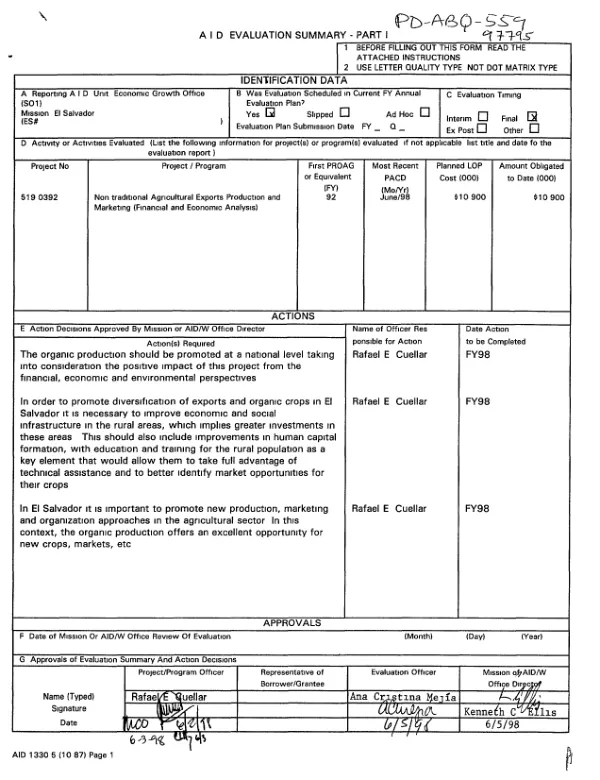
PACR of a project (6/91-6/98) to increase production and marketing of non-traditional agricultural exports (NTAEs) by cooperatives and participating small farmers in El Salvador.
2000
Sign in to readA free account is required to download.
Abstract
The Cooperative League of the USA (CLUSA) was the implementing agency. Market demand led to a shift in focus from NTAEs to non-traditional agriculture (NTA) in general, as well as from conventionally grown to organically grown NTAEs. The latter shift also reduced the use of chemical fertilizers and pesticides and had a positive impact on the environment and on farmers. The project had a significant impact on employment generation, production, net earnings, and area planted. Future Mission activities in these areas should include as much of the CLUSA/El Salvador methodology as possible. The project also improved the administrative capabilities of its assisted cooperatives, though much remains to be done, especially at the primary level. Future efforts to support agricultural organizations should include activities in institutional development, management, and organizational strengthening. While many participating secondary organizations have attained acceptable levels of sustainability, the situation with many primary level organizations is less certain. The sustainability of PROEXSAL has not yet been achieved and will be critical to the survival of many primary organizations with which the project has worked over the past years. The final evaluation recommended that CLUSA spend the final few months of the project making PROEXSAL and its members as sustainable as possible. The project had a recognized environmental impact, including reducing the use of synthetic agrochemicals and polluting agricultural byproducts, promoting soil conservation techniques, and rationalizing agrochemical policies. Circumstantial evidence indicates that the project helped create public awareness of the dangers of chemical-based agriculture and of the benefits of organ, environmentally friendly agricultural products. The final evaluation recommended that CLUSA"s activities in this direction be continued. Soil and compost testing has not been done either in a consistent manner nor over time. The same is true of crop- specific soil and compost testing. Future attempts to improve crop production should begin with extensive soil and soil amendment testing to determine nutrient levels and soil and amendment pH. Nutrient and pH levels should also be monitored on a regular basis. The project benefitted women significantly in terms of employment, training, and, to a lesser extent, assumption of leadership roles. Women received about 20% of the jobs created by the project and 12% of the training. In the past, these indicators for women were close to zero. Future Mission programs should include specific mechanisms that address the role of women and include at least one female technician trained in basic education techniques on its staff. Of all the development strategies that the Mission might adopt for El Salvador"s rural sector, CLUSA"s organic NTAE and NTA strategy is the one most likely to be successful. The following lessons were learned: (1) The factor that more than any other led to project success was the flexibility of project management and Mission project officers (2) The Spanish word "mystica", which combines dedication to work, a special way of relating to and respecting the people one is trying to assist, working long hours in often uncomfortable situations, and, most of all, enjoying the work, consistently came up whenever respondents explained their relationship with CLUSA staff, or the reasons why they thought CLUSA staff had been successful. (3) Project success was promoted by the decision to work through an NGO/PVO outside of both government and the many public or private bureaucracies where it could have been located. (4) The role of an expatriate senior manager is a critical factor of project success. If the person is allowed the flexibility, has the mystica, and works outside of normal bureaucratic channels, he/she can often achieve the trust and confidence of the people being assisted, as well as the trust and confidence of power brokers within a particular project.