USAID. MISSION TO COSTA RICA
Northern Zone consolidation
Summarizes mid-term evaluation (PD-ABD-546) of a project to promote agricultural development in the most northern zone of Costa Rica.
1992
Sign in to readA free account is required to download.
Abstract
The project has focused on increasing the production of nontraditional export crops, developing a road maintenance and rehabilitation system, improving social infrastructure, and providing land titles to land holders. The project has been implemented by a Coordination Office (PCO), which is organized as an extension of the Ministry of Planning. Evaluation covers the period 1988-9/92. Overall, project progress is unacceptable. While the Community Development, and Land Settlement and Titles components are well on track, the Road Rehabilitation and Maintenance, and Crop Diversification components are significantly behind schedule and are not likely to work given current implementation arrangements. The PCO has no autonomy and must operate through the Planning Ministry"s administrative, legal, and budgetary procedures. Approximately 2 years were required to negotiate agreements and contracts with public and private institutions participating in the project. The PCO"s monitoring responsibilities in relation to the Road Rehabilitation and Maintenance and Crop Diversification components have been unclear. In addition, there has been a lack of clearly defined amounts of resources the project would receive and when under current monetization levels, the latter problems becoming more critical over FY 91 and FY 92. The following lessons were learned. (1) As with many area-based integrated rural development projects, organizational issues have handicapped project start-up. Project designers had planned for the PCO to be a decentralized semi-autonomous unit, and designed manuals and fiscal plans in great detail. However, the autonomy idea did not materialize and duplication of effort has caused implementation delays and acute morale problems among contractors and project personnel. However, now that problems have been identified, and given the demonstrated will of the Project Director to help implement the necessary adjustments, there are improved prospects for achieving project objectives. (2) The project"s Environmental Management Office (EMO) has been unexpectedly successful in fostering environmental consciousness among development institutions in the area. This is credited to the professional, practical, but polite, manner of the EMO staff. (Author abstract) See also abstract of PD-ABD-546.
Related documents
Documents in this collection
 1970
1970USAID DEC
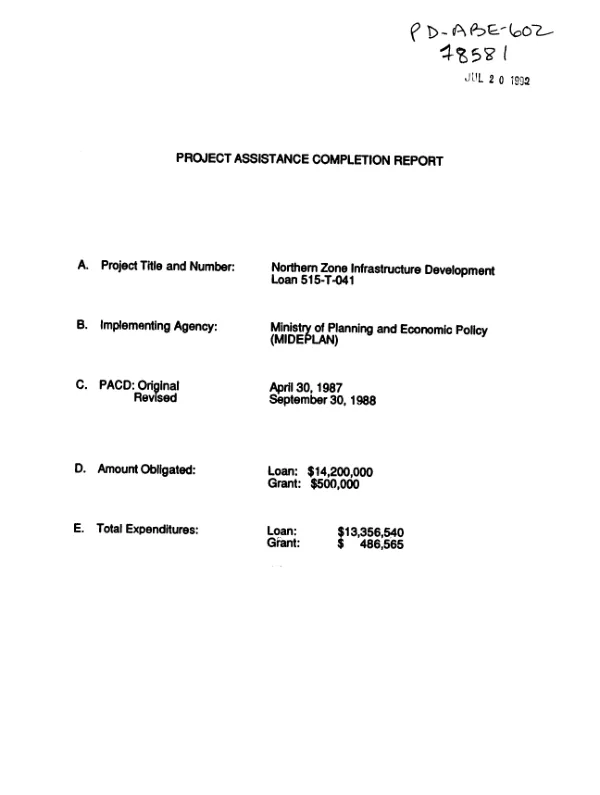
Project assistance completion report : northern zone infrastructure development, implementing agency -- Ministry of Planning and Economic Policy, Costa Rica
Open record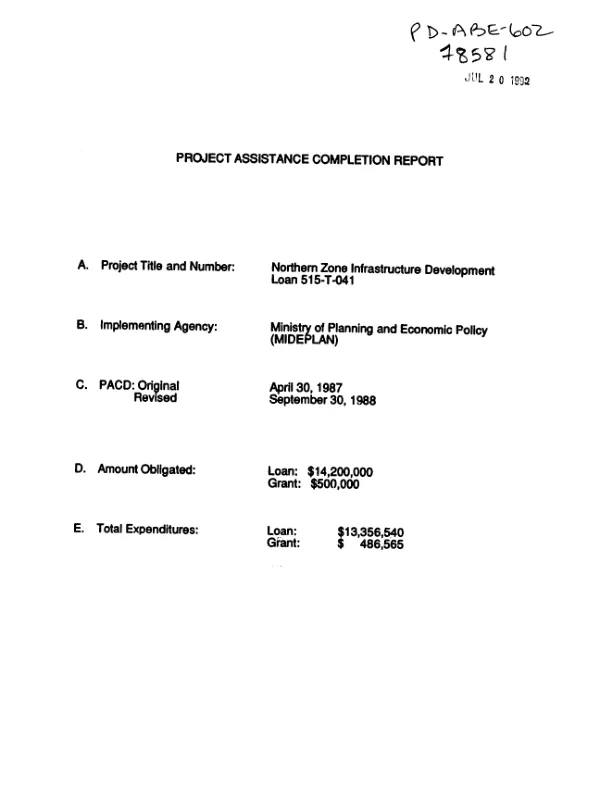
USAID DEC