USAID DEC
Nostalgia poveștilor despre URSS
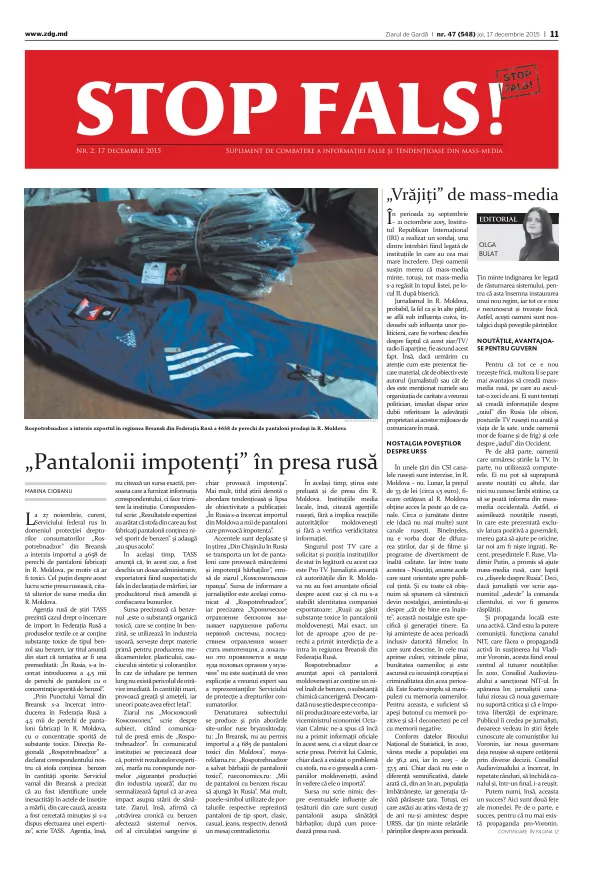
The Russian Federal Service for Supervision of Consumer Rights Protection and Human Well-being, "Rospotrebnadzor," in the city of Bryansk, has banned the importation of 4,685 pairs of pants manufactured in the Republic of Moldova due to concerns over toxic substances.
2015 · 4 pages
Sign in to readA free account is required to download.
Abstract
The pants allegedly contained high levels of benzene, a known carcinogen. According to the Russian news agency TASS, the attempt to import the pants was premeditated, with the goal of introducing toxic products into the Russian market. The pants were discovered to contain high levels of benzene during an inspection at the Bryansk customs point. The Russian authorities claim that the pants posed a risk to public health, particularly for men, who may experience impotence and other health problems due to prolonged exposure to benzene. However, the Moldovan authorities have not been notified about the issue, and the identity of the exporting company remains unknown. The incident has sparked a debate about the reliability of the Russian media and the influence of propaganda on public opinion. Many Moldovans rely on Russian news sources, which often present a biased view of events, and may be influenced by the government's agenda. The Moldovan media has also been criticized for its lack of objectivity and its tendency to echo the views of the Russian media. The incident has also highlighted the issue of nostalgia for the Soviet era, which is still prevalent in Moldova. Many people in Moldova have a romanticized view of the Soviet Union, which is often portrayed in a positive light in Russian media. This nostalgia can be exploited by politicians and media outlets to shape public opinion and influence people's perceptions of reality. In Moldova, the average age of the population is increasing, and many young people are leaving the country in search of better opportunities. However, the older generation still remembers the Soviet era and is often nostalgic for the perceived stability and security of that time. This nostalgia can be manipulated by politicians and media outlets to shape public opinion and influence people's perceptions of reality. The Moldovan government has been criticized for its handling of the incident, with some accusing it of being too passive and not doing enough to protect the country's interests. The incident has also raised concerns about the reliability of the Moldovan media and the need for greater transparency and accountability in the country's institutions. The Russian media has been accused of spreading propaganda and manipulating public opinion, particularly in relation to the incident involving the pants. The Russian government has been accused of using its media outlets to shape public opinion and influence people's perceptions of reality. The incident has highlighted the need for greater media literacy and critical thinking in Moldova, as well as the need for greater transparency and accountability in the country's institutions. In conclusion, the incident involving the pants manufactured in Moldova has highlighted the complex issues of propaganda, media literacy, and public opinion in Moldova. The incident has raised concerns about the reliability of the Russian media and the influence of propaganda on public opinion, as well as the need for greater transparency and accountability in the country's institutions.
Related documents