USAID DEC
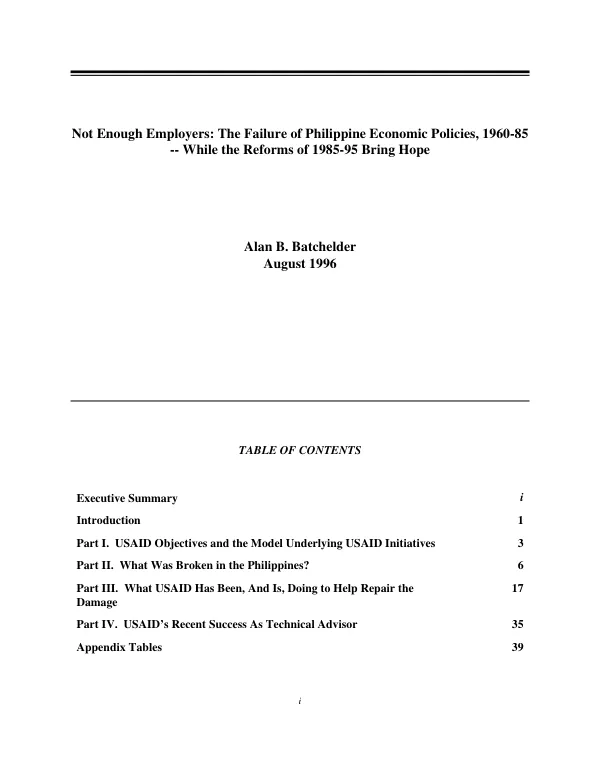
Not enough employers : the failure of Philippine economic policies, 1960-85 - while reforms of 1985-95 bring hope
Sign inUSAID. BUR. FOR GLOBAL PROGRAMS, FIELD SUPPORT AND RESEARCH. CENTER FOR ECONOMIC GROWTH. OFC. OF ECONOMIC AND INSTITUTIONAL REFORM
Not enough employers : the failure of Philippine economic policies, 1960-85 - while reforms of 1985-95 bring hope
From 1960 to 1985, Philippine economic policies repressed growth of demand for labor.
Batchelder, Alan B. · 1996
Sign in to readA free account is required to download.
Abstract
Consequently, poverty grew worse even though donors and IFIs funded many projects. Sustained reform to increase private demand for wage labor began in 1985 and accelerated after 1990. USAID"s Manila Mission was elaborately involved in dozens of reforms effective in accelerating growth, raising wages, and reducing poverty. The message of this report is that, at least from 1985 to 1995, the Mission"s role was critical in helping the Government achieve over 90 reforms. The message for USAID"s world-wide future is that, over time, the Mission moved away from high-cost conditioned aid and became highly effective, with relatively low-cost technical assistance supporting Government reform initiatives. In 1960, Philippine economic development was well ahead of that of Taiwan, South Korea, Malaysia, and Thailand. Relatively well-educated, English-speaking Filipinos, who were closely tied to the United States, appeared to have a more promising developmental future than did any of their East Asian neighbors. However, by 1985, Taiwan, South Korea, Malaysia, and Thailand were all enjoying sustained economic development, rising wages, and rapid poverty reduction. In contrast, Filipinos suffered economic stagnation, persistent low wages, and growing poverty. All five of these nations received substantial foreign assistance between 1960 and 1985. Such gifts benefited millions of Filipinos in selected "green-oasis cases" but left the majority of Filipinos to suffer the spreading poverty of a policy-oppressed, non-developing economy. The reason the four nations were successful is clear. They adopted -- with extensive USAID technical assistance (excepting Malaysia) -- policies that nourished growth in the numbers and success of private employers, many producing for export. Labor demand grew faster than supply could grow; so employers -- reluctant as they always are -- were compelled by competition for workers to pay higher and higher wages (doubling every 10-15 years). In turn, rising wages led manufacturers to switch from products and processes that delivered acceptable profits using cheap labor to products and processes that delivered acceptable profits while making labor more productive. In stark contrast, between 1960 and 1985, Philippine leaders perpetuated economic policies that protected monopolies while repressing growth in the number of competitive private businesses. The result: the number of job seekers grew faster than did demand for wage workers. Employers had no need to raise wages of the unskilled and semi-skilled, and the press of excess workers increased the extent and severity of Philippine poverty. But since 1985, Philippine Governments have been changing economic policies and institutions. The USAID Mission has been a key player pushing, cajoling, inspiring, and financing reform. This paper distinguishes eight categories of policy failure that tended to depress demand for wage labor: (1) import-substitution provisions held down employment in exporting; (2) government-designated monopolies restricted production and excluded additional employers; (3) discriminatory provisions kept out foreign employers; (4) various provisions encouraged substituting capital for labor; (5) financial-sector policies depressed savings and misdirected investment; (6) numerous provisions held down growth in demand for rural labor; (7) the revenue system failed to collect taxes either equitably or adequately to provide for infrastructure required for growth; and (8) flawed budget priorities left infrastructure (including supportive institutions) and human capital formation underfunded. The body of the paper reports the extent and the variety of USAID involvement assisting reforms in each of the eight areas. Though not an exhaustive inventory of USAID assistance with reform, the text cites USAID"s role in some 95 institutional and policy improvements, most of which contributed to the growth of demand for Filipino labor. This evidence permits the paper to conclude that if comprehensive policy and institutional reforms produce rapid growth and extensive poverty reduction in the Philippines, USAID will deserve credit for having been instrumental in facilitating many of those reforms during the decade, 1986-95. (Author abstract)