RICE UNIVERSITY
Numerical exposition of the Harberger model of tax and expenditure incidence
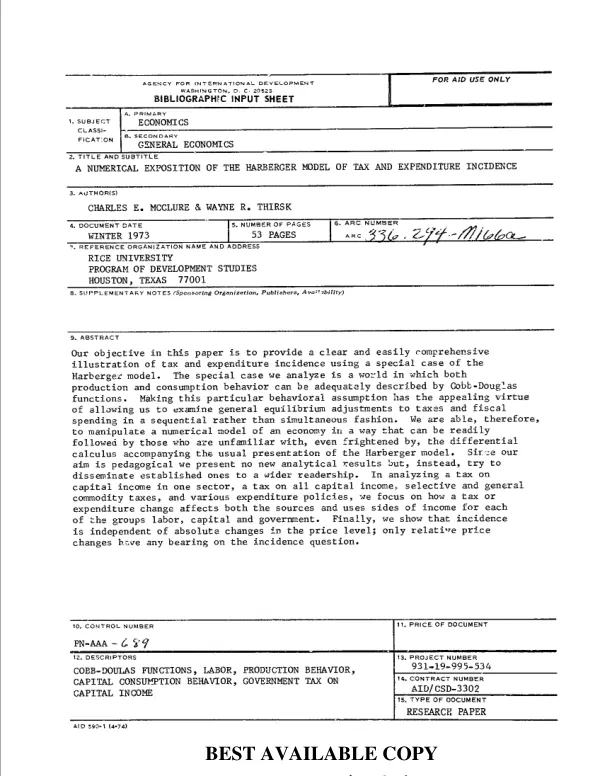
Our objective in this paper is to provide a clear and easily comprehensive illustration of tax and expenditure incidence using a special case of the Harberger model.
McLure, C. E.; Thirsk, W. R. · 1970
Sign in to readA free account is required to download.
Abstract
The special case we analyze is a world in which both production and consumption behavior can be adequately described by Cobb-Douglas functions. Making this particular behavioral assumption has the appealing virtue of allowing us to examine general equilibrium adjustments to taxes and fiscal spending in a sequential rather than simultaneous fashion. We are able, therefore, to manipulate a numerical model of an economy in a way that can be readily followed by those who are unfamiliar with, even frightened by, the differential calculus accompanying the usual presentation of the Harberger model. Since our aim is pedagogical we present no new analytical results but, instead, try to disseminate established ones to a wider readership. In analyzing a tax on capital income in one sector, a tax on all capital income, selective and general commodity taxes, and various expenditure policies, we focus on how a tax or expenditure change affects both the sources and uses sides of income for each of the groups labor, capital and government. Finally, we show that incidence is independent of absolute changes in the price level; only relative price changes have any bearing on the incidence question.
Connected topics