PARTNERSHIP FOR CHILD HEALTH CARE, INC.
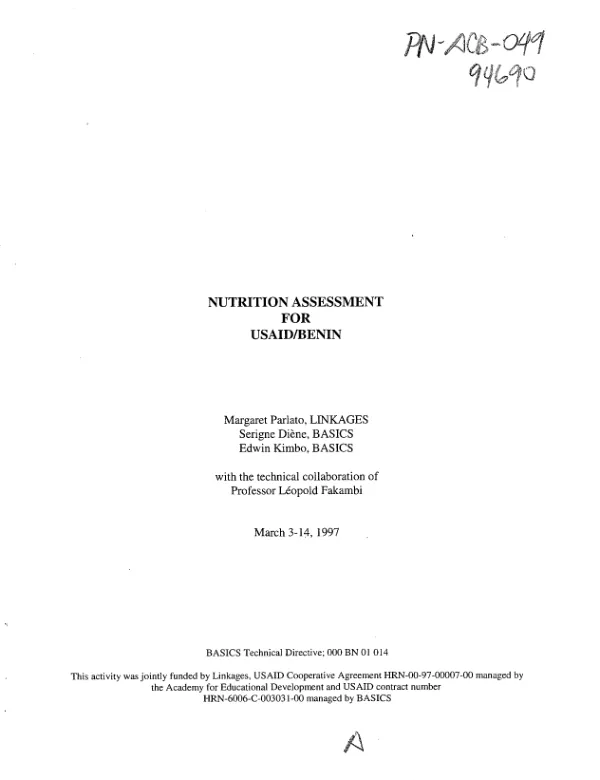
Nutrition assessment for USAID/Benin
In March 1996, an assessment was made of the status of programming possibilities for strengthening nutrition activities in Benin.
Parlato, Margaret; Diene, Serigne · 1997
Sign in to readA free account is required to download.
Abstract
Generally, the study found that the context for USAID investment in Benin"s nutrition sector is favorable. Specific findings were as follows. (1) There is widespread consensus that past nutrition efforts have failed, and a new nutrition model based on pilot programs is emerging. Leading nutrition program agencies have begun implementing new approaches that bring services directly to the community; include income generation activities, growth monitoring, and counseling; and give community groups an active voice and role. Targeted food supplements are found in the large World Bank and Catholic Relief Services (CRS) programs. (2) A number of donors (World Bank, UNICEF, and CRS) have recently initiated major new nutrition programs, offering important opportunities for collaboration and leveraging of USAID resources. (3) There is a critical mass of nutrition expertise in Benin, as well as institutions engaged in nutrition program research and evaluation. More than 100 technical specialists have emerged from the university since it began offering a nutrition program in 1980. These professionals can be found in public and private institutions throughout the country. (4) Demographic and health survey (DHS) findings, particularly those showing that poor birth spacing is directly linked to 40% of child malnutrition in the country, provide a strong base for understanding and initiating dialogue about nutrition in Benin. The report recommends that USAID: (1) support the national goal of promoting exclusive breastfeeding through 4 months and introduce the lactation amenorrhea method (LAM) as a postpartum option; (2) launch a social marketing program for prenatal iron/folate tablets; and (3) fund development of a behavior change approach to improve infant feeding practices, with elements that can be readily incorporated by the World Bank, CRS, UNICEF, and other ongoing nutrition programs. Further, the Agency should (4) implement MINPAK -- a basic package of key nutrition interventions -- in the zone chosen for implementation of the Family Health Project; and (5) develop a model for "franchising" local entrepreneurs and food vendors to sell an improved "weaning" food to low-income families in urban areas covered by the Family Health Project. Includes references and a list of contacts.
Related documents