USAID DEC
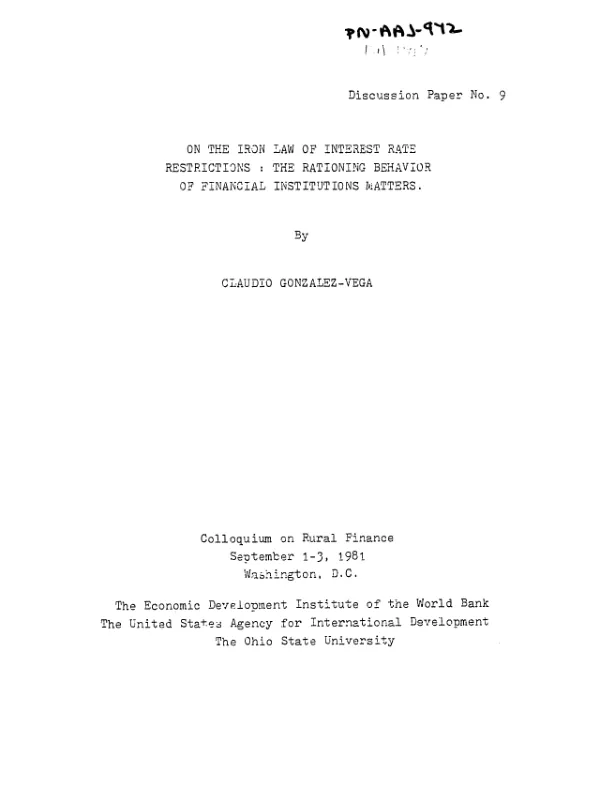
On the iron law of interest rate restrictions : the rationing behavior of financial institutions matters
Sign inOHIO STATE UNIVERSITY
On the iron law of interest rate restrictions : the rationing behavior of financial institutions matters
Formal financial institutions (FFI) in low-income nations, legally bound to provide to high-risk small farmers loans regulated by restricted interest rates (RIR), mitigate risks by rationing loans to wealthier farmers, thus worsening income distribution in rural areas.
Gonzalez Vega, Claudio · 1970
Sign in to readA free account is required to download.
Abstract
So argues the author of this paper examining the impact of RIR"s on borrowers and especially on lenders in low-income countries. A survey of traditional models for determining the impact of RIR"s reveals that while these models correctly indicate that borrowers suffer from RIR"s, they fail to specify or stratify the extent of harm. According to the author, the effect of RIR"s is to reduce both the size of FFI"s total portfolio of assets (which in turn reduces their ability to borrow from other financial intermediaries) and FFI loan portfolios, and to concentrate the allocation of FFI loans in favor of a smaller and wealthier class of farmers. Other effects of RIR"s are that FFI"s either change the non-interest terms of the loan (e.g., collateral) or reduce loan size. After reviewing types of non-price credit rationing used by lenders, (e.g., favoring export-oriented crops), the author develops his own model of lender/borrower behavior under RIR"s as summarized in the Iron Law of Interest Rate Restrictions: As interest ceilings become more restrictive, the size of loans granted to large producers increases while those to small producers decreases. Further, when RIR"s fall so low that they no longer cover the average variable costs of lending to small borrowers, FFI"s close their rural offices, thus increasing small farmers" transaction costs of securing a formal loan and forcing them into the high-cost informal credit sector. Finally, recognizing the hesitation of FFI"s to offer them credit, the majority of small borrowers do not apply for loans, thus creating the illusion of a lack of demand for credit when in fact many small farmers both desire and would benefit from FFI loans. In this way, it is concluded, RIR"s have become key determinants of the limited access to institutional credit and of the high degree of loan portfolio concentration that characterize rural financial markets in low-income countries. A 23-item list of references (1952-81) is appended.