USAID. BUR. FOR AFRICA. REGIONAL ECONOMIC DEVELOPMENT SERVICES OFC. (REDSO) EAST AFRICA
Operational program grant to CARE - Comoros
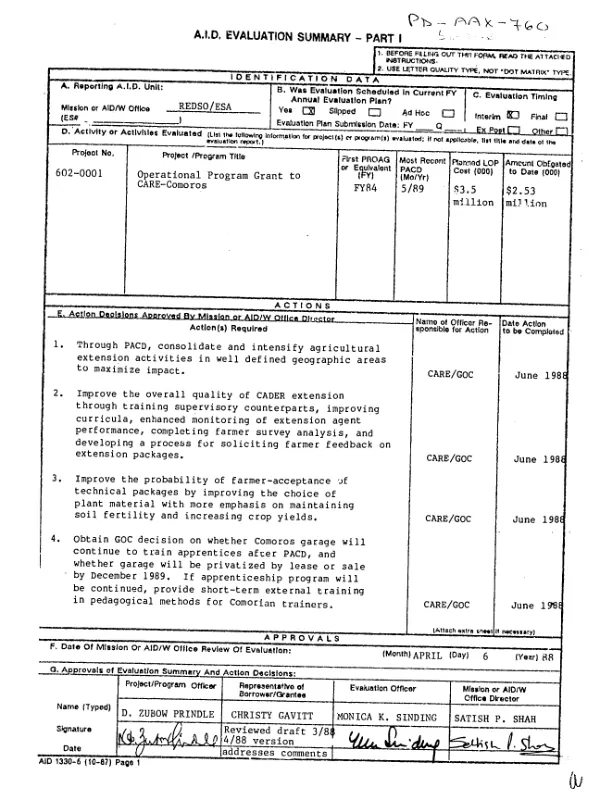
Summarizes attached interim evaluation (XD-AAX-760-A) of OPG to CARE to implement a land/soil conservation program on the Island of Anjouan.
1988
Sign in to readA free account is required to download.
Abstract
Evaluation covered 5/84-4/88 and was based on document review, site visits, and interviews. Components of the project, as implemented, are to: (1) disseminate agroforestry technologies and stabilize steep slopes by training extensionists, establishing nurseries and demonstration fields, providing tree cuttings, and multiplying grasses; and (2) establish a capacity to maintain/repair extension vehicles on Grande Comore and Anjouan Islands. The project environment on Anjouan is complex. Nine donors besides A.I.D. are helping individual Centers For Agriculture and Rural Economic Development (CADER"s) on Anjouan; still, no regular mechanism for high-level donor coordination exists, and the Government of Comoros" (GOC) capacity to generate and implement agricultural policy remains weak. GOC personnel need more training in policy analysis, financial appraisal, and fiscal and commodity management. Also, CARE has repeatedly expressed concern about the World Food Program"s practice of paying farmers for on-farm erosion control, since this may inhibit acceptance of the technical packages for their own value. The two regions (corresponding to two CADER"s) on Anjouan in which CARE is active show relatively modest impact to date; extension was only initiated in these areas with the onset of the project in 1984, nor has the technical quality of CARE"s soil conservation interventions been high. The vehicle repair/garage component requires a strategy for hand-over to the GOC (or privatization) by 12/89; this should include a decision whether the garages will continue to provide training or just services. The Grande Comore garage is becoming financially self-sufficient, but more effort is needed to attract clients, supplement receipts from CEFADER (the Federal CADER), review pricing on a quarterly basis, and reduce the delays in CEFADER"s payments for services received. Recommendations are to: (1) consolidate sites for plant material multiplication, demonstration, and extension to increase impacts; (2) improve extenionists" training and motivation; and (3) raise the technical quality of CARE"s soil conservation interventions, e.g., by increasing the number of visits from the Nairobi-based CARE Regional Technical Advisors to three a year. A new 5-year grant to CARE, to overlap with the 5/89 completion of the current project, is being proposed. The new grant will focus on expanding soil conservation/fertility enhancement efforts in Anjouan and (if consonant with other donor programs) providing extension training in other CADER"s on Anjouan. Also recommended is an agricultural sector review, the lack of which has hindered implementation of the present project.
Related documents