USAID. MISSION TO PAKISTAN
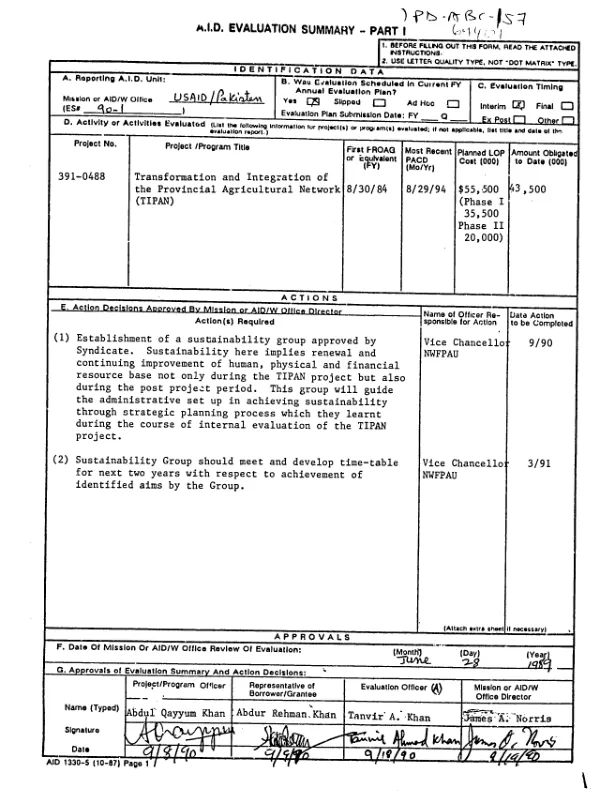
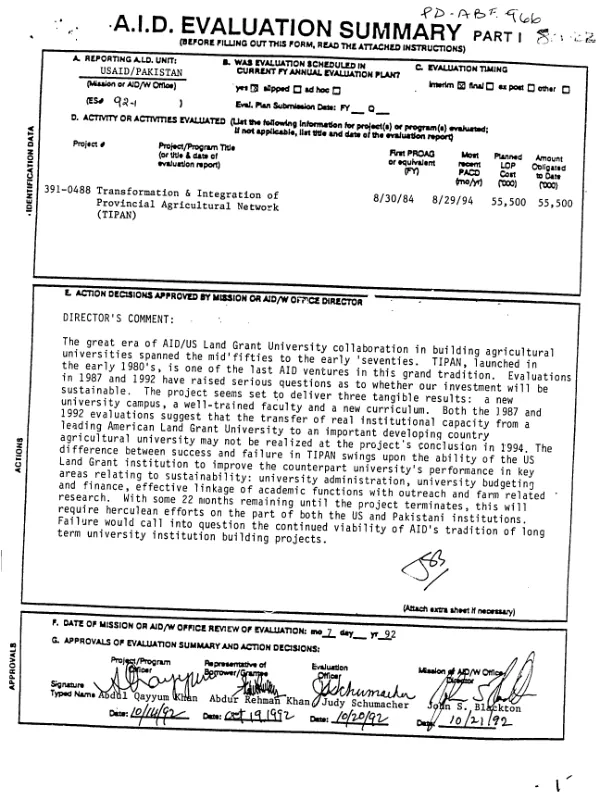
Transformation and integration of the Provincial Agricultural Network (TIPAN)
Summarizes interim evaluation (PD-AAY-120) of a project to upgrade and integrate agricultural research (AR) and education in Pakistan"s North West Frontier Province, and strengthen linkages with extension.
Tom, Fred T.; Bently, C. Fred +1 more · 1988
Sign in to readA free account is required to download.
Abstract
The evaluation covered the first 4 years of the 11-year project. The project has been successfully launched with generally enthusiastic support from agricultural universities (AU"s). Major findings follow. (1) A satisfactory administrative structure has been created, though some weaknesses persist in regard to research, rigidity in applying project targets, and structural problems in AU departments. (2) Progress in reformulating syllabi, curricula, and course content is on schedule at the B.S. level, but limited at the M.S. level. (3) Equipment is not being effectively used. (4) The split appointment concept for faculty and internal examination processes is not adequately understood. (5) Despite a new AR structure, major appointments, and funding increases, there is need for further structural, policy, and management changes and funding increases. (6) On-farm adaptive research and verification trials have produced more agricultural technology as a result of the new outreach policy, but much greater focus is needed on results appropriate to farmers. (7) The Learning Resources Center, a sound concept, is not yet making a major contribution. (8) Procurement is satisfactory, but maintenance and training are problematic. (9) Participant training is lagging; further delays will hinder project progress. The women"s program is also lagging. (10) Short-term TA has been inadequately planned and underutilized. (11) Host country support, while generally adequate, falls short of expectations. (12) Relations among project participants, especially between the AU"s and the TA team, have generally been good. (13) Major assumptions - that available budgetary resources and qualified local staff would be adequate and that merged research staff would welcome AU outreach initiatives - have proven somewhat optimistic. Major recommendations are to: continue the project without interruption into Phase II; retain the University of Illinois/Southern Illinois University TA team and expand it to the 7 members originally planned; and apply a high degree of flexibility for the duration of the project. Lessons learned are as follows. (1) Comprehensive restructuring of a major agricultural network is complex and apt to take years of rigorous effort. (2) Collaborative projects require careful definition of roles and responsibilities. (3) Institutional reforms have socioeconomic impact only over time. (4) Where physical improvements and construction are vital to institutional restructuring, TA and construction plans should be balanced and realistic.
![Project assistance completion report : UAF/GRTSM [University of Agriculture, Faisalabad/Grain Research, Training and Storage Management (Cell)] project activities, July - August, 1994](https://covers.devme.ai/gen/7043.webp)