USAID DEC
Optimizing individual and public health benefits of assisted HIV self-testing through effective linkages to services for men who have sex with men and transgender women in Laos
Sign inFHI 360
Optimizing individual and public health benefits of assisted HIV self-testing through effective linkages to services for men who have sex with men and transgender women in Laos
The LINKAGES project in Lao PDR, initiated in 2016 with funding from USAID and PEPFAR, implemented assisted HIV self-testing (HIVST) in coordination with government authorities and facilities.
2019 · 1 pages
Sign in to readA free account is required to download.
Abstract
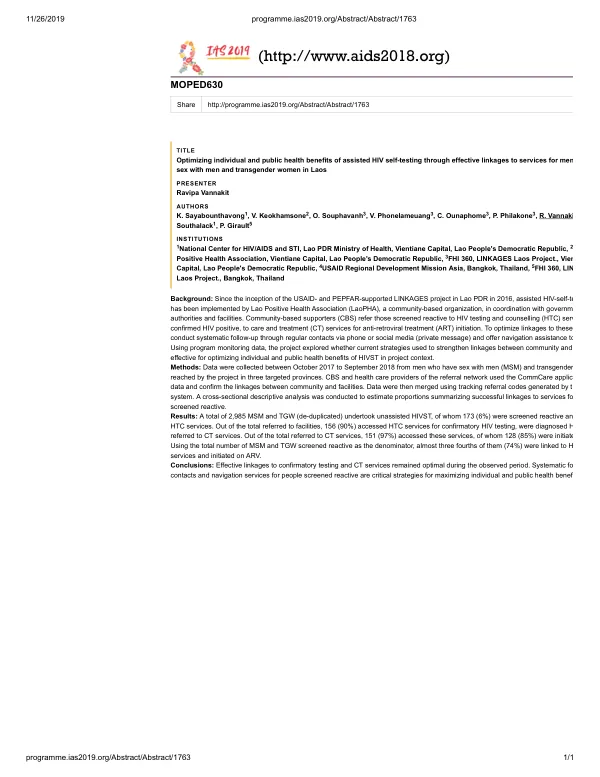
Community-based supporters (CBS) referred individuals screened reactive to HIV testing and counseling (HTC) services to care and treatment (CT) services for anti-retroviral treatment (ART) initiation. To optimize linkages to these services, the project conducted systematic follow-up through regular contacts via phone or social media and offered navigation assistance to individuals screened reactive. Data collected between October 2017 and September 2018 from men who have sex with men (MSM) and transgender women (TGW) reached by the project in three targeted provinces revealed that 173 (6%) of 2,985 individuals undertook unassisted HIVST were screened reactive and referred to HTC services. Of those referred, 156 (90%) accessed HTC services for confirmatory HIV testing, were diagnosed HIV positive, and referred to CT services. Out of the total referred to CT services, 151 (97%) accessed these services, of whom 128 (85%) were initiated on ART. The results indicate that effective linkages to confirmatory testing and CT services remained optimal during the observed period. Systematic follow-up contacts and navigation services for individuals screened reactive are critical strategies for maximizing individual and public health benefits. The project's findings suggest that the current strategies used to strengthen linkages between community and facilities are effective in optimizing the individual and public health benefits of HIVST in the project context. The LINKAGES project's approach to HIVST and linkage to care and treatment services has been implemented in coordination with government authorities and facilities. The project's community-based supporters play a crucial role in referring individuals screened reactive to HTC services and facilitating their access to CT services. The project's systematic follow-up contacts and navigation services have been critical in maximizing individual and public health benefits. The project's findings have implications for the scale-up of HIVST and linkage to care and treatment services in Lao PDR and other countries. The results suggest that effective linkages to confirmatory testing and CT services can be achieved through systematic follow-up contacts and navigation services. The project's approach can be replicated in other settings to optimize the individual and public health benefits of HIVST.
Related documents