USAID DEC
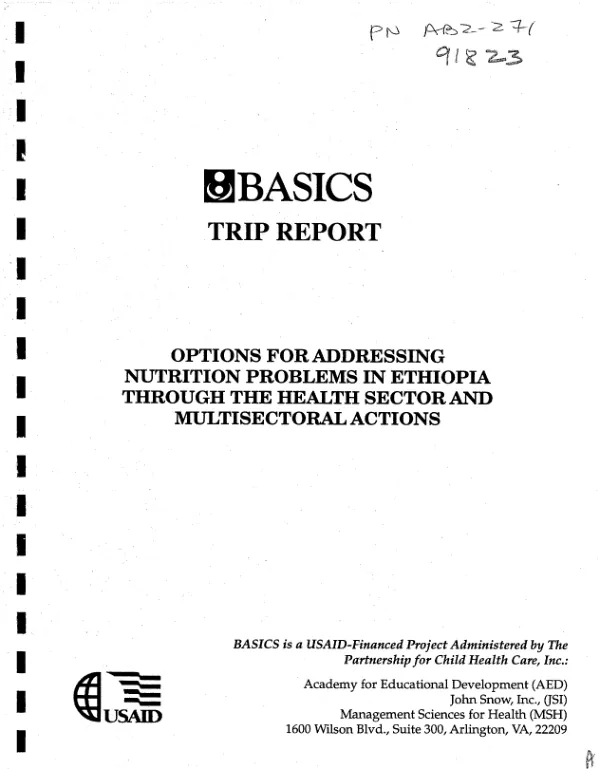
Options for addressing nutrition problems in Ethiopia through the health sector and multisectoral actions
Sign inPARTNERSHIP FOR CHILD HEALTH CARE, INC.
Options for addressing nutrition problems in Ethiopia through the health sector and multisectoral actions
This report identifies the major types of nutrition problems in Ethiopia, provides an analytical framework that identifies their causes, and suggests options for addressing them through USAID programs.
Pelletier, David · 1994
Sign in to readA free account is required to download.
Abstract
Ethiopia suffers from a high prevalence of chronic protein-energy malnutrition (PEM), vitamin A deficiency, iodine deficiency disorders and, to a lesser extent, iron deficiency anemia. It is recommended that the Essential Health Services for Ethiopia (ESHE) project address the micronutrient deficiencies by supporting national programs already underway, but PEM is a more intractable problem which does not lend itself to solution through health sector interventions alone. The analytical framework identifies four immediate causes of PEM among women: high work demands; large number of closely spaced births; inadequate nutrient intake; and high burden of disease. The framework suggests four priorities for the ESHE project and two for USAID"s country program as a whole. The project should support: (1) an information, education, and communication (IEC) program focusing on key infant feeding problems: use of pre-lacteal feeds, nonexclusive breastfeeding during the first 6 months, inappropriate introduction of weaning foods, and poor nutritional management of illness; (2) national programs against micronutrient malnutrition, including vitamin A supplementation, iron supplementation for women, and monitoring of salt iodine content; (3) selective food supplementation for high-risk women and young children, using advanced design principles; and (4) community-based health interventions that include multi-sectoral actions. The USAID country program should: (1) strengthen the capacity of Addis Ababa University to support regional training centers, in part by establishing links with a U.S. school of public health and a U.S. land grant university; and (2) use food aid more creatively to achieve multiple objectives, e.g., curtailing environmental degradation, improving access to water, fuel sources, markets and social services, stimulating off-farm employment in land-poor regions, improving household incomes and food security, and reducing women"s workloads. This approach is justified by the huge food deficit in the country, which reduces the potential impacts on incentives for local production, and the self-targeting nature of schemes that direct benefits to the poor. ESHE, as a largely facility-based health project, can have only limited impact. The most promising approaches involve community-based activities, creative use of food aid, and the improved multi-sectoral policy and planning that would arise from national and regional training. It is important that cross-sectoral discussions continue within USAID/Ethiopia in order to identify and seize whatever opportunities exist for complementarities among programs. Includes references.
![Nutrition of young children and mothers in Ethiopia : findings from the 2000 Ethiopia demographic and health survey [DHS]](https://covers.devme.ai/gen/74316.webp)