DUAL & ASSOCIATES, INC.
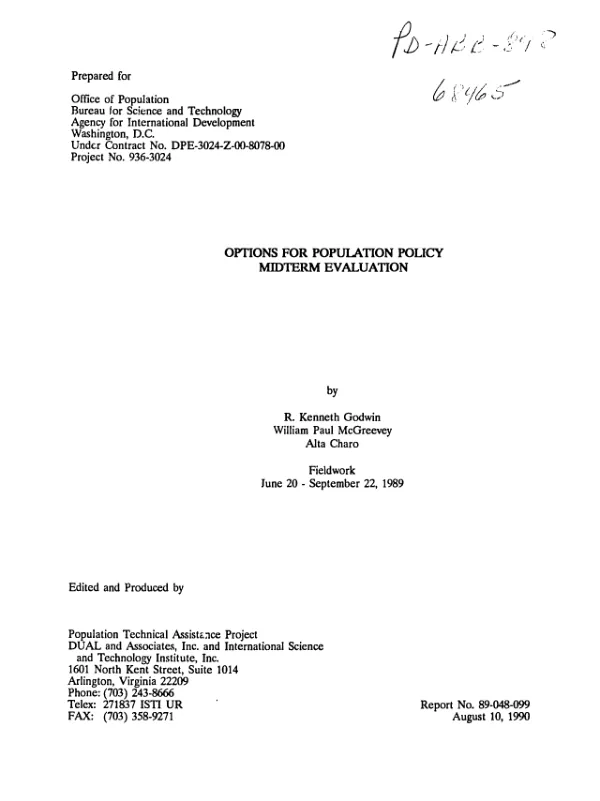
Options for population policy : midterm evaluation
Mid-term evaluation of a project to encourage the adoption by developing countries of national population policies and programs aimed at reducing fertility rates.
Godwin, R. Kenneth|McGreevey, William Paul|Charo, Alta · 1990
Sign in to readA free account is required to download.
Abstract
The evaluation covers the period 10/86-9/89. The project has performed well, with particularly strong success in helping countries adopt population policy statements. Four countries have adopted such statements while five others have developed draft policies. The project's greatest contribution in this area has been its creation of useful policy tools, including: analyses of rules and regulations that assist or inhibit fertility reduction; benefit-cost analyses; programming and budgeting methodologies; and management information systems. These tools have been applied in 35 cases in 22 countries. The project has also had a strong impact on the shift of resources to population programs, and has helped a considerable number of countries build indigenous capacity to provide family planning services and initiate action plans to implement these services. Various support activities (e.g., training, observational travel, long-term TA, fellowships, and information services) appear to have contributed to the project's overall success, although precise impact is difficult to measure. The project's success is also evident in that it is ahead of schedule, has been fully supported by regional office and Mission buy-ins, and has received a favorable review from Mission staff and participating governments. Impact on the private sector has been limited, partly due to the project focus on Africa, where the private sector is not well developed. (A.I.D. should consider how project emphases on both the private sector and Africa can be reconciled.) However, some noteworthy achievements have been made in encouraging public- private sector collaboration and in developing policies to support private sector provision of family planning services. The project has been instrumental in redefining policy as a set of actions rather than a mere statement of intent. The stage is now set for a follow-on project that will focus more directly on these programmatic and operational aspects, especially in regard to contraceptive availability, where project work is just beginning.