PAN AMERICAN HEALTH ORGANIZATION (PAHO)
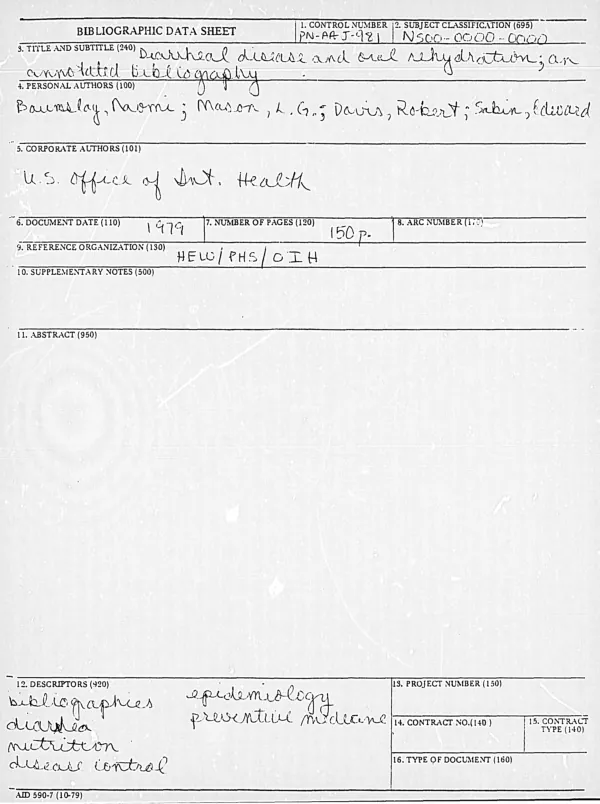
Oral rehydration therapy : an annotated bibliography
Oral rehydration therapy (ORT) is quickly becoming an inexpensive, easily administered, and universally available way of combating dehydration caused by diarrheal diseases.
Baumslag, Naomi; Davis, Robert E. · 1970
Sign in to readA free account is required to download.
Abstract
This annotated bibliography was compiled to assist in understanding ORT as a means to treat dehydration and is organized in five sections. The first section contains 17 references pertaining to the history of the development of solutions used for oral rehydration. Glucose and electrolyte solutions have been used over the past 30 years and studies showed that the coupled transport of glucose and sodium in the small intestine results in accelerated transport of electrolytes and water. Studies conducted on ORT and its relationships to cholera are also included. Contained in the next section are 28 references describing clinical trials yielding information on methods of ORT administration, the reduced need for intravenous therapy, and the limitations of ORT. Most of these references address the efficacy of ORT as a means of treating cholera and infant diarrhea. References on the composition of oral rehydration solutions, treated in the next 23-item section, investigate the use of a single sodium concentration for all diarrheal cases, the feasibility of using sucrose instead of glucose, and the determination of the optimal potassium concentration. The next section, containing 12 references, treats the impact of ORT on morbidity and mortality resulting from diarrheal diseases. Accurate impact measurement is confounded by multiple factors such as wide variations in environmental, socioeconomic, and cultural characteristics; unreliable epidemiological data; and differences in the levels of training of those administering ORT. The last 58 references examine issues concerning implementation of ORT such as the training needed for administration, where ORT should be administered, the method of distribution, the mode of preparation, and the assessment of fluid requirements. Appended are a sequential bibliography (1949-79) and author and country indices.
Related documents