CORNELL UNIVERSITY. NEW YORK STATE COLLEGE OF AGRICULTURE AND LIFE SCIENCES
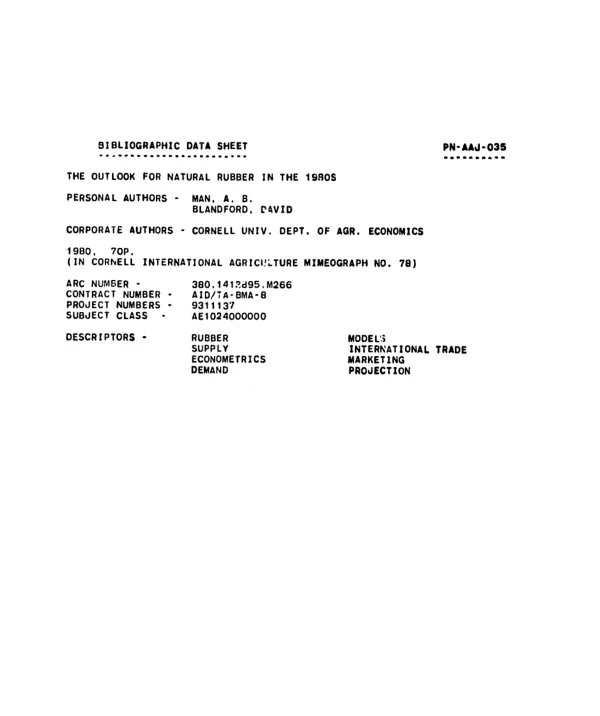
OUTLOOK FOR NATURAL RUBBER IN 1980S
The rising price of oil, the main source of synthetic rubber, has given natural rubber, a key developing country export, a new economic lease on life.
MAN, A. B.; BLANDFORD, DAVID · 1970
Sign in to readA free account is required to download.
Abstract
This paper describes the natural and synthetic rubber industries and markets and estimates a model to calculate the prospects for natural rubber. The world"s natural rubber market is dominated by Asia, especially Malaysia, Indonesia, and Thailand; Africa, led by Liberia and Nigeria; and South America. Most of this natural rubber is exported to industrialized countries, particularly the United States, Japan, and China, although exports have declined in some traditional markets like Eastern Europe due to increased use of synthetic rubber. Synthetic rubber only began to be mass-produced during World War II, but accounted for 67.6% of the world"s rubber market by 1975, with the United States leading the way. The dependence of natural rubber production on weather and time -- it can take a rubber tree 7 years to mature -- -gives synthetic rubber a competitive edge, as does the synthetic rubber industry"s tightly controlled and oligopolistic character. Extensive research has led to a technical superiority of synthetic over natural rubber in major end-uses in which the two are interchangeable. This superiority has kept synthetic rubber prices low and is forcing natural rubber to be increasingly price-competitive. To analyze natural rubber"s future prospects, an econometric model to explain production, consumption, and inventories and prices of both natural and synthetic rubber is estimated for the period 1960-1977. By 1985, natural rubber demand should increase 9-13% above 1977 levels, with the largest relative increase coming from the Japanese tire sector (although demand will decrease in other Japanese sectors). U.S. demand will basically stagnate. Production will increase in Malaysia and Thailand, but decline elsewhere. Prices of natural rubber will increase in low- and high-income growth areas by 100% and 150% respectively. These increases, comined with rising oil prices, should double the real price and hence the value of natural rubber to exporting countries by 1985. A 39-item bibliography (1939-80) is appended.
Related documents