ABT ASSOCIATES
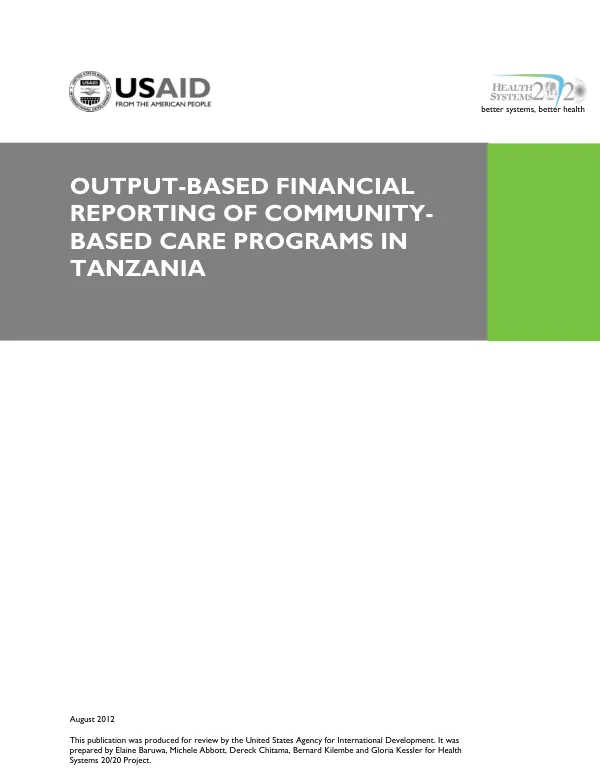
Output-Based Financial Reporting of Community-Based Care Programs in Tanzania
Health Systems 20/20 is a flagship project of the United States Agency for International Development (USAID) aimed at strengthening health systems worldwide.
2012 · 73 pages
Sign in to readA free account is required to download.
Abstract
The project supports countries to improve their health financing, governance, operations, and institutional capacities. By eliminating barriers to the delivery and use of priority health care, such as HIV/AIDS services, tuberculosis treatment, reproductive health services, and maternal and child health care, Health Systems 20/20 helps improve health outcomes. The project focuses on output-based financial reporting of community-based care programs in Tanzania. Output-based financial reporting is a methodology used to track and report on the costs and outcomes of health programs. This approach allows for more accurate and transparent financial reporting, enabling better decision-making and resource allocation. The report outlines the methodology used to collect and validate data for the output-based financial reporting of community-based care programs in Tanzania. The data collection process involved initial partner visits and validation, as well as capacity building activities to ensure that partners had the necessary skills and knowledge to collect and report accurate data. The results of the output-based financial reporting are presented in the report, with a focus on the costs and outcomes of different types of community-based care programs in Tanzania. The report presents data on the costs of different program components, including household-based care (HBC) and orphans and vulnerable children (OVC) programs. The report also presents data on the costs of educational supplies packages and the costs of capacity building activities. The report highlights the importance of program management, program design, and policy in achieving the goals of community-based care programs. The report recommends that implementing partners improve their efficiency by streamlining their activities and reducing costs. The report also recommends that program designers consider the scale and service package of the program when designing community-based care programs. The report concludes that output-based financial reporting is a valuable tool for tracking and reporting on the costs and outcomes of community-based care programs. The report recommends that USAID and other stakeholders continue to support the use of output-based financial reporting in community-based care programs. The report includes several annexes that provide additional information on the cost data use framework, definitions, list of partners, capacity building activities, educational supplies packages, and bibliography. The report also includes several tables and figures that present data on the costs and outcomes of different community-based care programs in Tanzania. The report highlights the importance of regional variation in costs, with costs varying significantly across different regions in Tanzania. The report also highlights the importance of prime/sub-recipient pairing, with prime partners playing a critical role in managing and overseeing sub-recipients. Overall, the report provides valuable insights into the costs and outcomes of community-based care programs in Tanzania and highlights the importance of output-based financial reporting in tracking and reporting on the costs and outcomes of these programs.
Related documents