USAID DEC
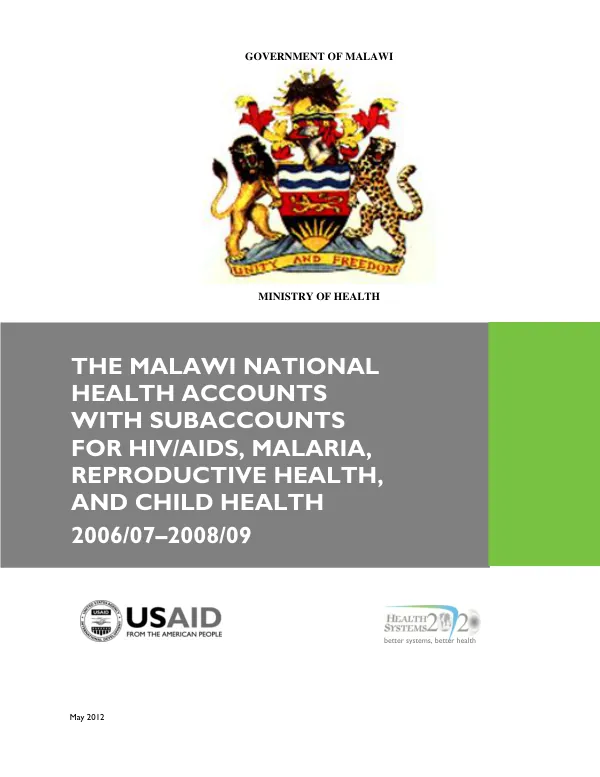
Malawi National Health Accounts with Subaccounts for HIV/AIDS, Malaria, Reproductive Health, and Child Health for Financial Years 2006/07, 2007/08, and 2008/09
Sign inABT ASSOCIATES
Malawi National Health Accounts with Subaccounts for HIV/AIDS, Malaria, Reproductive Health, and Child Health for Financial Years 2006/07, 2007/08, and 2008/09
The Malawi National Health Accounts with subaccounts for HIV/AIDS, Malaria, Reproductive Health, and Child Health for Financial Years 2006/07, 2007/08, and 2008/09 were developed to provide a comprehensive framework for understanding the country's health financing systems.
2012 · 179 pages
Sign in to readA free account is required to download.
Abstract
The study aimed to identify the sources and uses of health expenditures, as well as the financing agents and health providers involved in the delivery of health services. Malawi's social structure, economy, and health system were characterized by a high population growth rate, a predominantly rural population, and a weak health infrastructure. The country's health system was organized around a decentralized structure, with the Ministry of Health responsible for overall policy and coordination. The health delivery system was composed of public and private providers, including hospitals, clinics, and community health workers. The study found that total health expenditure in Malawi increased from MK 12.4 billion in 2006/07 to MK 17.3 billion in 2008/09, representing a growth rate of 39.5%. The public sector accounted for the largest share of health expenditure, followed by the private sector. The study also identified significant disparities in health expenditure between different regions and districts, with the northern region receiving the lowest share of health expenditure. The HIV/AIDS subaccount found that total HIV/AIDS expenditures increased from MK 1.4 billion in 2006/07 to MK 2.3 billion in 2008/09, representing a growth rate of 64.3%. The majority of HIV/AIDS expenditures were allocated to antiretroviral therapy (ART) and prevention of mother-to-child transmission (PMTCT) programs. The study also found that the private sector played a significant role in providing HIV/AIDS services, particularly in the areas of ART and PMTCT. The Malaria subaccount found that total Malaria expenditures increased from MK 1.1 billion in 2006/07 to MK 1.6 billion in 2008/09, representing a growth rate of 45.5%. The majority of Malaria expenditures were allocated to insecticide-treated bed nets (ITNs) and indoor residual spraying (IRS) programs. The study also found that the public sector played a significant role in providing Malaria services, particularly in the areas of ITNs and IRS. The Reproductive Health subaccount found that total Reproductive Health expenditures increased from MK 1.2 billion in 2006/07 to MK 1.8 billion in 2008/09, representing a growth rate of 50%. The majority of Reproductive Health expenditures were allocated to family planning and maternal health programs. The study also found that the private sector played a significant role in providing Reproductive Health services, particularly in the areas of family planning and maternal health. The Child Health subaccount found that total Child Health expenditures increased from MK 1.5 billion in 2006/07 to MK 2.2 billion in 2008/09, representing a growth rate of 47.3%. The majority of Child Health expenditures were allocated to immunization and nutrition programs. The study also found that the public sector played a significant role in providing Child Health services, particularly in the areas of immunization and nutrition. The study's findings have significant policy implications for the Government of Malawi and other stakeholders involved in the country's health sector. The study highlights the need for increased investment in the health sector, particularly in the areas of HIV/AIDS, Malaria, and Reproductive Health. The study also emphasizes the importance of strengthening the health infrastructure, improving the efficiency of health services, and increasing access to health care for marginalized populations.