DAI GLOBAL, LLC
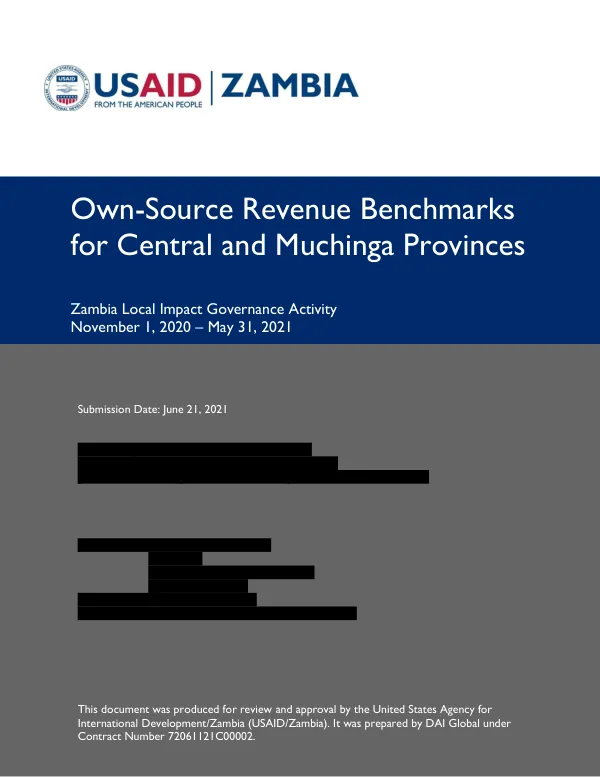
Own-Source Revenue Benchmarks for Central and Muchinga Provinces, Zambia
The Own-Source Revenue Benchmarks for Central and Muchinga Provinces in Zambia were conducted by the USAID Local Impact Governance Activity in April and May 2021.
2021 · 22 pages
Sign in to readA free account is required to download.
Abstract
The benchmarking exercise aimed to enhance the effectiveness and efficiency of local government authorities (LGAs) in Zambia by identifying strengths and weaknesses, and opportunities for improvement. The scope of the exercise was limited to own-source revenue (OSR) only. The benchmarking methodology was informed by the review, analysis, and assessment of three dimensions: the policy environment; an assessment of revenue performance; and an assessment of the tax administration. The results of the assessment are presented in a complementary report produced by Local Impact entitled "Revenue Generation Viability Assessment Zambia: Own Source Revenue Mobilization in Central and Muchinga Provinces – Volume 1", which also identifies prioritized opportunities and interventions for improving OSR. The OSR to GDP ratio is a gauge of an LGA's revenue relative to the size of its economy. A higher OSR to GDP ratio means that the district economy's tax/non-tax buoyancy is strong, and that the council has more fiscal space. The average OSR collected in 2020 for the 18 district councils is 0.36% of GDP. Nakonde recorded the highest collection at 1.2% of GDP, while Chama and Mafinga collected the lowest OSR as a percentage of GDP, which amounted to 0.7%. The revenue gap is defined as the difference between estimated potential and actual OSR. Computing the tax gap provides LGAs and their stakeholders with a measure of the amount of revenues lost or foregone through noncompliance, avoidance, and policy decisions. As part of this study, estimates of how much revenue each district could potentially raise were produced using data envelopment analysis (DEA). DEA answers the question 'how much revenue could each district from its current tax/non-tax base raise if it operated in line with the best performing LGA in the population of 18 cases?' The results of the DEA analysis showed that the revenue gap varies significantly across the 18 LGAs, with some districts having the potential to raise significantly more revenue than they currently do. The benchmark data presented in this report provides a picture of the OSR system, structure, revenue performance, and the application of resources and practices across the 18 LGAs. The data will be used to compare performance across the district councils in the population, for target setting, and monitoring and evaluation. A repeat exercise would provide trend data that would highlight whether there have been improvements over time. The next steps recommended in this report include focusing on indicators such as the OSR to GDP ratio, revenue gap, and operating surplus or deficit. These indicators will provide a basis for target setting and monitoring and evaluation. Additionally, the report recommends that LGAs prioritize opportunities and interventions for improving OSR, such as enhancing the policy environment, improving revenue performance, and strengthening tax administration. The OSR Benchmarks for Central and Muchinga Provinces provide a valuable tool for LGAs in Zambia to assess their performance and identify areas for improvement. The benchmarks will help LGAs to set realistic targets and monitor their progress towards achieving these targets. The report also highlights the need for LGAs to prioritize opportunities and interventions for improving OSR, and to strengthen their tax administration and revenue performance.