DAI GLOBAL, LLC
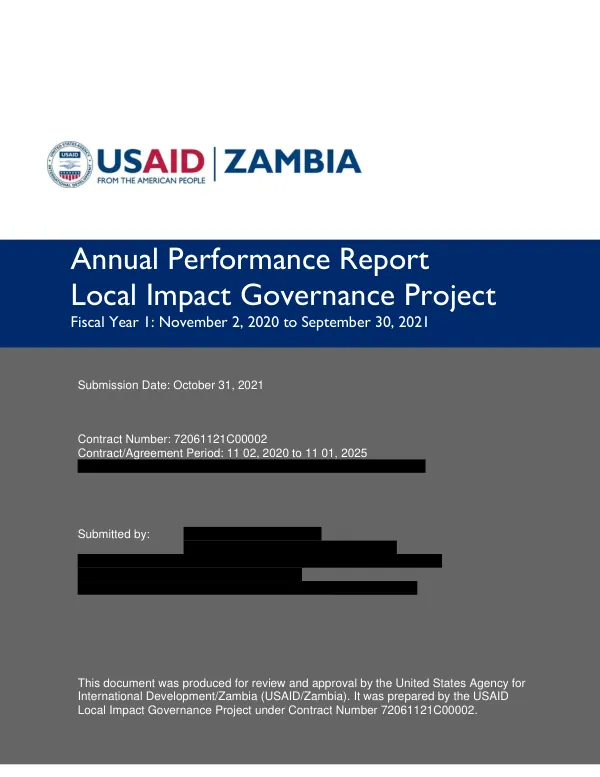
Annual Performance Report: Local Impact Governance Activity
The Local Impact Governance Project in Zambia began on November 2, 2020, and is set to conclude on November 1, 2025.
2021 · 36 pages
Sign in to readA free account is required to download.
Abstract
The project aims to help Zambia develop a sub-national system of governance for devolved service delivery that is more responsive to citizen needs. The project's objectives include enabling citizens to effectively assess service delivery needs and performance, making the subnational governance system more responsive to citizen needs, and generating learning and facilitating problem-solving for subnational governance systems. The project's geographic coverage includes Central and Muchinga provinces in Zambia, with the Government of the Republic of Zambia (GRZ), civil society organizations, and the private sector as target beneficiaries. The project's planned life of project is 5 years, with a total funding of $19,112,974. As of September 30, 2021, the project had an obligation of $5,045,000, with an average monthly expenditure of $172,460. The project's implementation progress during the first year was impacted by several contextual factors, including the COVID-19 pandemic and the August 2021 national elections. Despite these challenges, the project managed to submit all required Inception Phase deliverables on or before May 31, 2021, and implemented most of the planned Quarter 3 and Quarter 4 activities included in the Year 1 Annual Work Plan. The project's implementation context was characterized by three key factors: the COVID-19 pandemic surges in December 2020/January 2021 and June/July 2021, the conduct of the August 2021 national elections, and the changing priorities of a newly elected administration. The project team had to adapt to these challenges, including delayed establishment of an office in Lusaka, recruitment of staff, and engagement of key decentralization stakeholders. The project's Monitoring, Evaluation, and Learning (MEL) updates indicate that the project has made progress in achieving its objectives, despite the challenges faced. The project has implemented several activities, including the development of an Activity Monitoring, Evaluation, and Learning Plan (AMELP), the conduct of a political economy analysis of decentralization, and the establishment of a Ward Development Committee (WDC) in each of the 15 wards in the project area. The project's stakeholder involvement has been a key aspect of its implementation, with the project team engaging with various stakeholders, including the GRZ, civil society organizations, and the private sector. The project has also established a Technical Working Group (TWG) to provide technical support and guidance to the project team. The project's key recommendations for the next year include continuing to support the GRZ in its efforts to decentralize power and resources, strengthening the capacity of local government authorities, and promoting citizen engagement and participation in local governance. The project also recommends continuing to monitor and evaluate the project's progress, and making adjustments as necessary to ensure that the project is on track to achieve its objectives. The project's indicator results summary indicates that the project has made progress in achieving its objectives, with a 27% increase in household income among program participants compared to the control group. The project's success stories include the establishment of a Ward Development Committee (WDC) in each of the 15 wards in the project area, and the development of an Activity Monitoring, Evaluation, and Learning Plan (AMELP) to support the project's MEL activities. The project's financial progress report indicates that the project has made significant progress in terms of expenditure, with an average monthly expenditure of $172,460. The project's pipeline indicates that there are still significant funds available for expenditure, with a pipeline of $3,147,938.