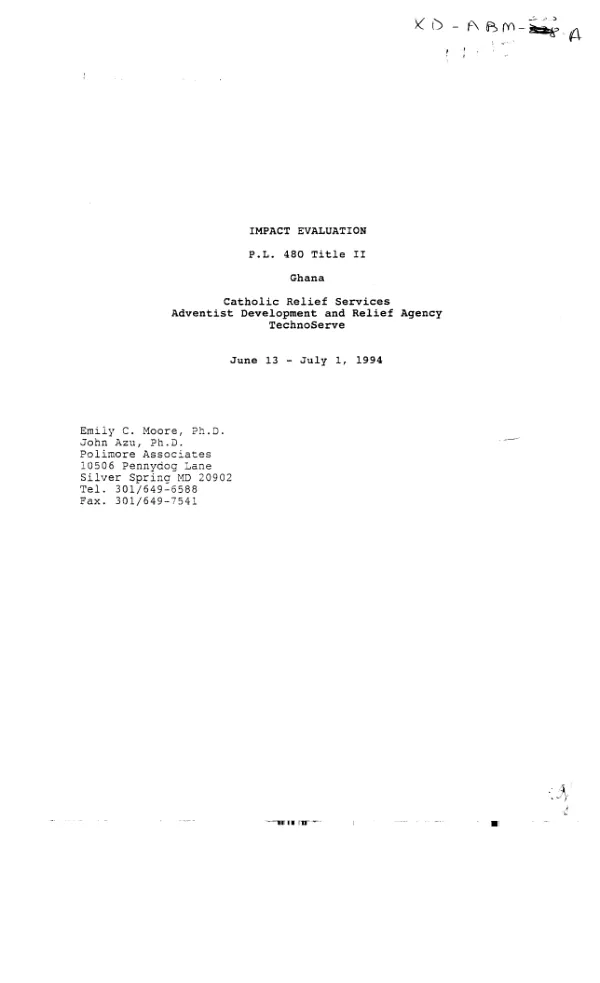
USAID. MISSION TO GHANA
P. IL. [i.e. PL] 480 Title II program
Evaluates ongoing (since 1958) P.L.
1995
Sign in to readA free account is required to download.
![P. IL. [i.e. PL] 480 Title II program](https://covers.devme.ai/gen/13301.webp)
Abstract
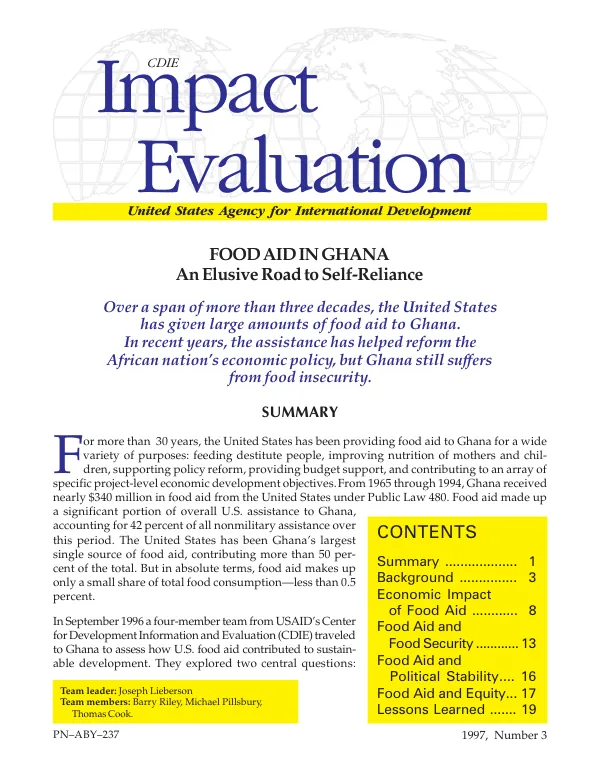
480 Title II program in Ghana, currently being implemented by the Adventist Development Relief Agency (ADRA), Catholic Relief Services (CRS), and Technoserve, Inc. ADRA has made considerable progress in management, planning, and program focus and is expected to improve further with a recent change in senior management; however, the Agency needs immediate helped in upgrading monitoring and evaluation capabilities. ADRA plans to reduce its scope, including the number of projects and areas where it is active (which currently number 10 regions), and will attempt to combine interventions and activities through cluster programming. The sustainability of the agricultural projects implemented by ADRA during the past 3-7 years appears to be excellent. The projects are expected to exceed their targets. One example of measurable achievement was the significant increase in enrollments and attendance in assisted schools. Dry season gardening, which ADRA completed in 1987, is being sustained, although many of the project"s outputs and impacts could not be evaluated. ADRA interventions in agroforestry through the Community Collaborative Forestry Initiative (CCFI) supported the Mission"s environmental protection target of opportunity. Other programs supported the Mission"s food security goals (food availability by means of their agroforestry projects, food access through increased income, and food consumption/utilization through better health status and improved sanitation and potable water resulting from Kumasi Ventilated Improved Pit (KVIP) latrines and well programs). Mission education objectives were supported through ADRA"s construction of schools. Plans to support small-scale cashew and mango production demonstrated ADRA"s commitment to support the Mission"s nontraditional export strategic objective. CRS has phased out its maternal child health (MCH) and school feeding activities in all but three regions and has shifted from nationwide to streamlined (targeted) programs; it is also attempting cluster programming. Reduction in scope has resulted in a concentration of staff expertise and energies (CRS is transferring its staff to Tamale to be close to its projects in the Northern sector) that bodes well for the future. There were more increases in female attendance in schools where school lunches were provided than in schools without lunch programs, with overall attendance increasing in program areas by 7.5%. Two of the four grain bank projects in the Volta region, as well as the grain project in Upper East, were very successful. For the first time, 100 participating families had enough to eat and produced a surplus which could be sold. The introduction of proper storage practices reduced post-harvest losses to almost zero. CRS has completed a baseline survey in primary health care (PHC) in some target communities, focusing on environmental sanitation; trained village health workers in PHC practices; and constructed soakaway pits outside most houses in the communities. CRS supports Mission"s objectives through health interventions, such as village health worker training and environmental sanitation; food consumption through improved grain storage; and, in support of the Mission"s educational and gender equity objectives, through school rehabilitation, the provision of school lunches, and a program to increase girls" enrollment in and attendance at school. TNS-assisted projects reduced post-harvest losses. The seasonal inventory credit program resulted in an increase in member incomes. The spillover effects of TNS assistance include road repairs, increased sales in local stores, and local construction. The inventory credit program anticipated a total of 246 MTs for storage by 6 cooperatives, but only 176 tons were realized in 1993. TNS devotes a substantial proportion of its budget to monitoring, evaluation, and research as well as staff training. TNS supports the Mission"s objectives to increase nontraditional exports, and to improve food security, by implementing projects to increase incomes and food production. The following lessons were learned. (1) PVO activities that support Mission strategic objectives complement microenterprise and community-based small-scale development efforts and enhance overall Mission objectives in Ghana. (2) PVOs need strong management capabilities both in the field and at their headquarters to manage programs. (3) PVO programs should not be too broad in scope or geographical focus, but focused to ensure impact through the tracking of clear and measurable indicators.
![ADRA/Ghana"s food security program (PL 480 Title II) : FFP-A-00-02-00015-0 [i.e. FFP-A-00-02-00015-00] -- FY 2002-FY-2006 : impact evaluation -- final report](https://covers.devme.ai/gen/51800.webp)
![ADRA/Ghana's food security program (PL 480 Title II) : FFP-A-00-02-00015-0 [i.e. FFP-A-00-02-00015-00] -- FY 2002-FY-2006 : impact evaluation -- final report](https://covers.devme.ai/gen/4731.webp)