USAID DEC
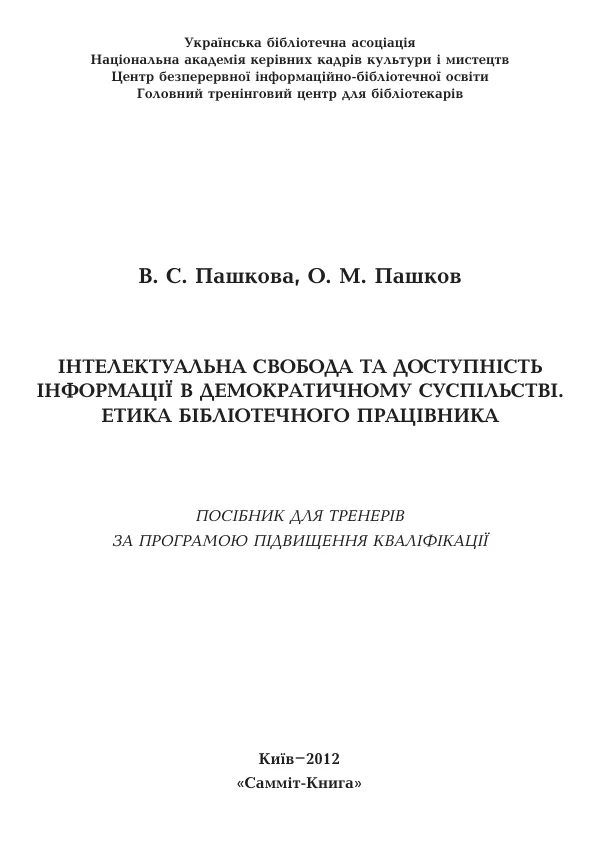
Інтелектуальна свобода та доступність інформації в демократичному суспільстві. Етика бібліотечного працівника
Sign inUSAID DEC
Інтелектуальна свобода та доступність інформації в демократичному суспільстві. Етика бібліотечного працівника
The document "Інтелектуальна свобода та доступність інформації в демократичному суспільстві.
2012 · 68 pages
Sign in to readA free account is required to download.
Abstract
Етика бібліотечного працівника" was published in 2012 by the Ukrainian Library Association, National Academy of Management of Culture and Arts, and the Center for Continuous Information and Library Education. The document is a guide for trainers in the "Бібліоміст" program, which aims to develop methodological recommendations for conducting training sessions for trainers at Regional Training Centers. The guide covers several topics related to intellectual freedom and the role of libraries in protecting it. The first part of the guide explores the concept of intellectual freedom, its importance in a democratic society, and the role of libraries in promoting it. The authors discuss the concept of intellectual freedom, its history, and its significance in the context of library and information services. The guide also examines the relationship between intellectual freedom and library and information policy, highlighting the importance of libraries in promoting access to information and protecting intellectual freedom. The authors discuss the role of libraries in providing access to information, promoting literacy, and supporting lifelong learning. The second part of the guide focuses on the professional ethics of librarians, including the code of ethics for librarians, confidentiality, and social responsibility. The authors discuss the importance of confidentiality in library and information services, highlighting the need for librarians to maintain confidentiality and protect users' personal information. The third part of the guide explores the role of library communities in ensuring the principle of intellectual freedom in library and information services. The authors discuss the importance of library associations in promoting intellectual freedom, highlighting their role in advocating for the rights of library users and promoting access to information. The guide includes a list of recommended literature and a plan for conducting training sessions for trainers. The authors provide recommendations for trainers on how to conduct training sessions, including plans for lectures, discussions, and practical exercises. The document is relevant to librarians, library managers, and information professionals who are interested in promoting intellectual freedom and access to information in a democratic society. The guide provides a comprehensive overview of the concept of intellectual freedom, its importance in a democratic society, and the role of libraries in promoting it. The guide is divided into three parts: the first part explores the concept of intellectual freedom and its importance in a democratic society; the second part focuses on the professional ethics of librarians; and the third part examines the role of library communities in ensuring the principle of intellectual freedom in library and information services. The guide includes a plan for conducting training sessions for trainers, which includes plans for lectures, discussions, and practical exercises. The authors provide recommendations for trainers on how to conduct training sessions, including tips on how to engage participants and promote active learning. The document is written in Ukrainian and includes a list of recommended literature in Ukrainian and English. The guide is relevant to librarians, library managers, and information professionals who are interested in promoting intellectual freedom and access to information in a democratic society.
Related documents