USAID
ფერმერის გზამკვლევი
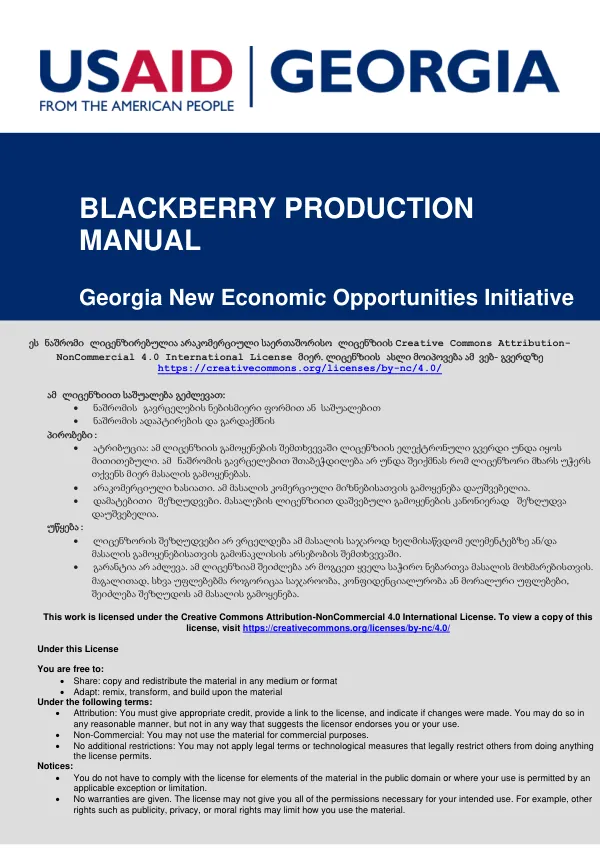
The manual for blackberry production in Georgia, titled "Farmer's Guide," was developed by David Picha and published in 2014.
97 pages
Sign in to readA free account is required to download.
Abstract
The guide is intended for farmers, agronomists, specialists, hobby gardeners, and other interested individuals. It provides information on the cultivation of blackberries, including soil selection, planting, and pest management. Blackberries are a high-value crop that can be grown in Georgia's diverse agricultural conditions. However, their production is currently limited, and the guide aims to provide a comprehensive resource for farmers to improve their yields and quality. The manual covers topics such as soil selection, planting, and pest management, as well as the use of organic and inorganic fertilizers. The guide emphasizes the importance of selecting a suitable location for blackberry cultivation, taking into account factors such as soil type, drainage, and sunlight. It also recommends using a well-draining soil with a pH between 6.0 and 7.0. The manual provides detailed information on the different types of blackberries, including their characteristics, growth habits, and uses. In terms of soil selection, the guide recommends using a well-draining soil with a pH between 6.0 and 7.0. It also emphasizes the importance of selecting a location with good air circulation to prevent disease and promote healthy growth. The manual provides detailed information on the different types of blackberries, including their characteristics, growth habits, and uses. The guide also covers topics such as pruning, training, and harvesting, as well as the use of organic and inorganic fertilizers. It provides detailed information on the different types of fertilizers, including their composition, application rates, and benefits. The manual also covers pest management, including the use of integrated pest management (IPM) techniques to minimize the use of chemical pesticides. In addition to providing information on blackberry cultivation, the guide also covers topics such as marketing and sales, including the use of social media and online platforms to promote blackberry products. It also provides information on the economic benefits of blackberry production, including the potential for high returns on investment. Overall, the "Farmer's Guide" provides a comprehensive resource for farmers and other stakeholders interested in blackberry production in Georgia. It covers a wide range of topics, from soil selection and planting to pest management and marketing, and provides detailed information on the different types of blackberries and their uses.
Related documents