USAID DEC
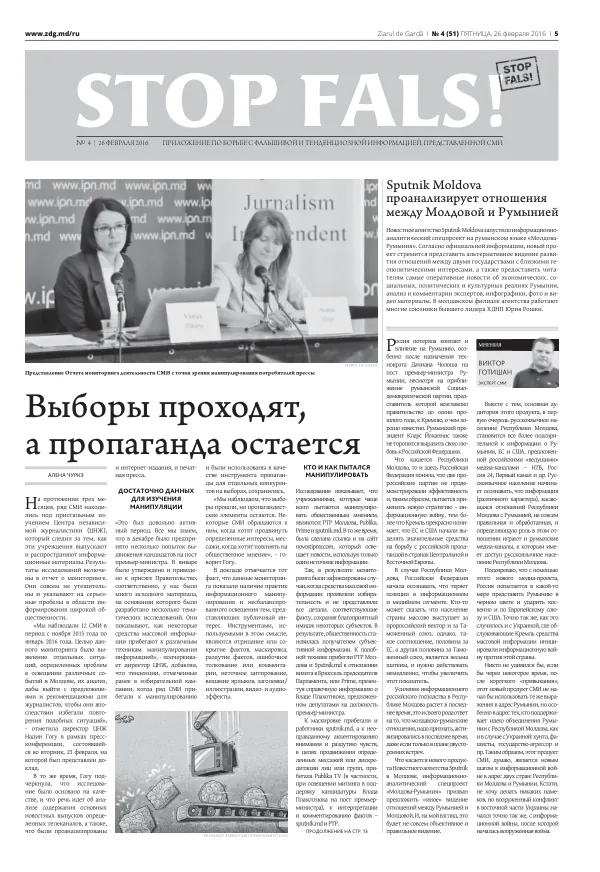
Отчет мониторинга деятельности СМИ с точки зрения манипулирования потребителей прессы
Sign inPRIME INTERNATIONAL, INC.
Отчет мониторинга деятельности СМИ с точки зрения манипулирования потребителей прессы
The Center for Independent Journalism (CIJ) conducted a three-month monitoring of 12 Moldovan media outlets from November 2015 to January 2016.
2016 · 4 pages
Sign in to readA free account is required to download.
Abstract
The goal of the monitoring was to identify specific situations, analyze problems in the coverage of various events in Moldova, and provide recommendations for journalists to avoid similar situations in the future. The monitoring revealed serious gaps in informing the public about various events in Moldova. The study found that some media outlets used techniques of information manipulation and biased coverage of public interest events. These techniques included denying or concealing facts, masking, exaggerating facts, misinterpreting or commenting on facts, inaccurate citation, labeling, headlines/illustrations, video and audio effects. The study identified the following media outlets as the most frequent manipulators of public opinion: RTR Moldova, Publika, Prime, and sputnik.md. Additionally, the website novostipmr.com was mentioned as a source of news that uses only one source of information. The monitoring revealed cases where media outlets showed bias and did not present all the facts, maintaining a favorable image of certain subjects. As a result, the public received subjective information. RTR Moldova and Sputnik.md used this technique when covering the visit of the Parliament's chairman to Brussels, presenting a brief information about Vlad Plahotniuc, proposed by deputies as prime minister. The study also found that some media outlets used techniques such as masking, misinterpreting or commenting on facts, and inaccurate citation. Sputnik.md and RTR Moldova were identified as using these techniques, while Publika TV used labeling and exaggeration to promote certain messages or discredit individuals or groups. The Russian Federation has lost contact and influence on Romania, especially after the appointment of technocrat Dacian Ciolos as prime minister, despite the approach of the Romanian Social Democratic Party, which had previously led the government, to the Kremlin. The Romanian president, Klaus Iohannis, has not rushed to express his love for the Russian Federation. In the case of the Republic of Moldova, the Russian Federation has come to understand that the two pro-Russian parties have not demonstrated effectiveness and is trying to apply a new strategy - information warfare, given that the Kremlin is well aware that the EU and the US have started to allocate significant funds to combat Russian propaganda in Central and Eastern European countries. The Russian Federation has started to realize that it is losing positions in the information and media segment in the Republic of Moldova. While some may say that the population of the country is massively in favor of the pro-Russian vector and the Customs Union, this ratio, with half in favor of the EU and the other half in favor of the Customs Union, is quite fragile and needs to be addressed immediately to increase this indicator. The increase in Russian information dominance in the Republic of Moldova is a response to the activation of Moldovan-Romanian relations, even if only in the context of bilateral meetings. The new product of the Sputnik News Agency in Moldova, the information-analytical special project "Moldova-Romania", aims to provide an alternative view of the relations between the two countries. However, this view is not objective and is likely to be biased. The main audience of this product is the Russian-speaking population of the Republic of Moldova, which is becoming increasingly suspicious of information about Romania, the EU, and the US provided by Russian media channels, such as NTV, Russia 24, and Channel One. The Russian-speaking population is starting to realize that the information provided about the relations between the Republic of Moldova and Romania is not accurate and is being manipulated, with a determining role played by Romanian media channels that are accessible to the Russian-speaking population. It is suspected that the Russian Federation will use this new media project to present Romania in a negative light and indirectly attack the EU and the US, just as it did with Ukraine, where the Russian media initiated an information war against the country.