CREATIVE ASSOCIATES INTERNATIONAL INC.
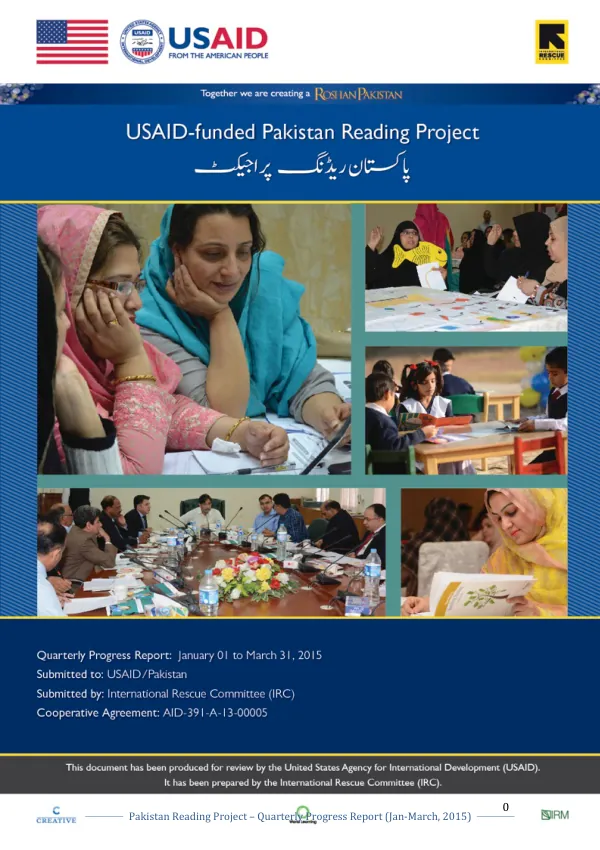
Pakistan Reading Project – Quarterly Progress Report (Jan-March, 2015)
The Pakistan Reading Project is a five-year initiative funded by the United States Agency for International Development (USAID) to improve reading skills of children in grades one and two throughout Pakistan.
2015 · 78 pages
Sign in to readA free account is required to download.
Abstract
The project is implemented by the International Rescue Committee (IRC) and its partners, including Creative Associates, World Learning, and the Institute of Rural Management. The project's objective is to support provincial and regional departments of education to enhance the quality of primary education. The project is structured into three components: teacher education, policy reforms, and community support for reading in Pakistan. In the reporting period of January to March 2015, the project successfully completed the formation process of Material Review Committees (MRCs) in all provinces and regions of Pakistan. The MRCs reviewed materials developed by the project, including workbooks, big books, scripted lesson plans, and flashcards, and provided feedback that was incorporated into the materials. The project also finalized five Urdu manuals for face-to-face trainings as part of its continuous professional development (CPD) model. Additionally, 10 teacher inquiry group (TIG) modules for year 1 were finalized, and a draft outline of TIG modules for year 2 was prepared. Material developed for teaching reading was designed in three parts, each comprising eight academic weeks, and was finalized and sent for printing. The project distributed TIG modules, scripted lesson plans, and manuals for face-to-face trainings to 434 mentors, 93 academic supervisors, 5,408 teachers, 23 reading specialists, and 1,385 head teachers in all provinces and regions, except FATA. The distribution of TIG material is still in progress, and a consolidated number will be reported in the next quarter. The project also organized training sessions for reading specialists, mentors, academic supervisors, and head teachers. A five-day training was organized for 23 reading specialists, a six-day session trained 434 mentors, and a three-day PRP Orientation was facilitated for 93 academic supervisors. Additionally, 1,385 head teachers were oriented about their role in TIGs, and 1,554 head teachers were trained in a five-day face-to-face teacher training, which trained a total of 5,408 teachers. The project successfully developed the first version of virtual mentoring videos (VMVs), which were shared with teachers for their review and feedback. A short messaging service (SMS) system was also developed to support Urdu, Sindhi, and English languages, and 25 audio phonic lessons were developed to help teachers teach the pronunciation of Urdu letters. In collaboration with the Higher Education Commission (HEC) of Pakistan, a reading curricula outline development workshop was organized, in which 22 teacher educators from universities, elementary colleges, and apex institutions participated. The project also works with 3,649 scholarship recipients, of whom 688 students have received complete scholarship installments for their teacher education degree programs. The disbursement of the remaining 2,682 scholarships is in process. To justify and solicit the required approvals from the education departments, the project developed an assessment tool and administered it in the assessment units of AJK, GB, FATA, Balochistan, and KP. Based on the initial feedback received on this tool, the project will develop a situation analysis report during the next quarter and submit it to the steering committees for their comments and approval. The project followed up with the education departments of all regions and provinces to seek nominations of officials and complete the necessary formalities for the Study Tour to Egypt planned for April 2015. The project also identified two thematic areas (gender and children with special needs) in consultation with IRC's technical unit for the solicitation of further support.