GOVERNMENT OF TAJIKISTAN
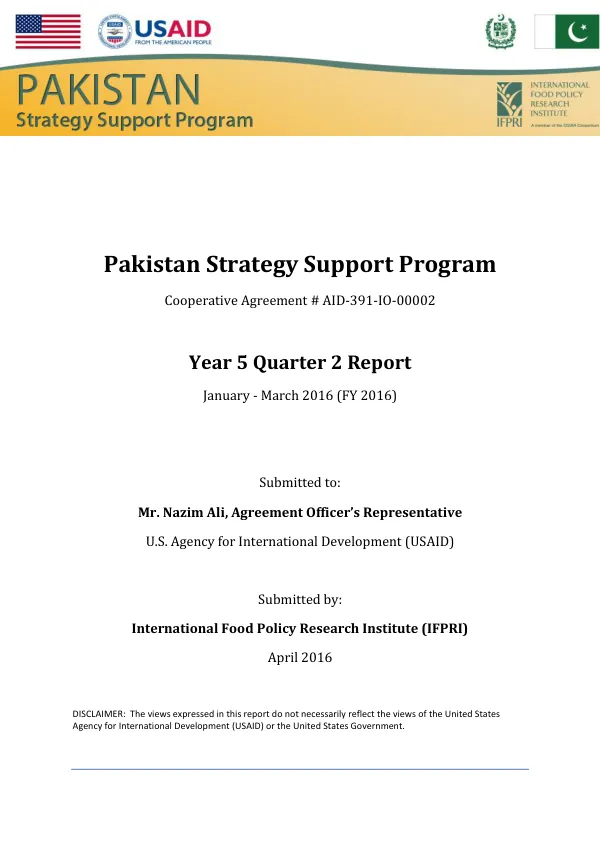
Pakistan Strategy Support Program – First Quarter Report – FY 2015
The Pakistan Strategy Support Program (PSSP) is a country-led and country-wide policy analysis and capacity strengthening program launched in July 2011 in response to a request from the Government of Pakistan (GOP).
2016 · 38 pages
Sign in to readA free account is required to download.
Abstract
The program's core purpose is to contribute to pro-poor economic growth and enhanced food security through strengthened national capacity for designing and implementing evidence-based policy reforms. PSSP's objectives are highly consistent with those of the Vision 2025, which was promulgated by the Planning Commission under the current GOP. PSSP's five primary research and capacity building priorities are agricultural production and productivity, water management and irrigation, macroeconomics, markets, and trade, poverty reduction and job creation, and a Competitive Grants Program. In addition to generating policy-relevant research, PSSP aims to improve policy analysis and advocacy, and build the capacity of researchers in selected GOP and non-government institutions through capacity strengthening, feedback, and outreach, and policy advisory programs. The program is linking Pakistani researchers and institutions through targeted efforts to develop knowledge-sharing networks. During the second quarter of FY 2016 (January - March 2016), PSSP's activities focused on increasing and improving agricultural and economic policy research, improving access to and demand for high-quality research among policymakers, academics, and other researchers, and enhancing policy-making benefits from informed input by private sector and civil society organizations. PSSP staff and collaborative research were key components of the program's activities, with a focus on increasing capacity building opportunities for researchers and analysts. The program also established and operated networks of agricultural and economic research organizations and universities, and provided timely, demand-driven policy analysis and advice to policymakers and other key stakeholders. PSSP's research networks were established to facilitate the exchange of ideas and knowledge among researchers and policymakers. The program's seminars, workshops, and conferences provided a platform for researchers to present their findings and engage with policymakers and other stakeholders. Meetings with private sector and civil society stakeholders were also held to gather their input and feedback on policy issues. The program's research was disseminated through various channels, including publications, datasets, and media coverage. PSSP's capacity strengthening activities focused on building the capacity of researchers in selected GOP and non-government institutions. The program worked with the Pakistan Agricultural Research Council (PARC), the Planning Commission, and civil society organizations to provide training and capacity building opportunities. The program's capacity strengthening activities were designed to improve the ability of researchers to conduct policy-relevant research and analyze information to formulate evidence-based policy recommendations. The program's progress on its indicators was reviewed during the second quarter of FY 2016. The review showed that PSSP had made significant progress in achieving its objectives, particularly in increasing and improving agricultural and economic policy research, and improving access to and demand for high-quality research among policymakers, academics, and other researchers. However, challenges and lessons learned were also identified, including the need to improve the program's monitoring and evaluation system, and to enhance its capacity to conduct policy-relevant research.
Related documents