NEAR EAST FOUNDATION
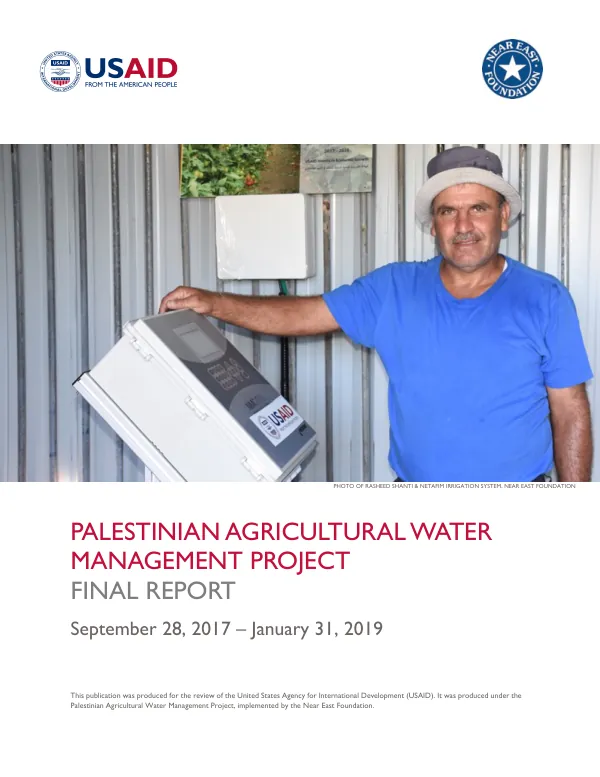
Palestinian Agricultural Water Management Project FINAL REPORT
The Palestinian Agricultural Water Management project was a partnership between the United States Agency for International Development (USAID), the Near East Foundation (NEF), Netafim, Middle East Investment Initiative (MEII), Palestinian Center for Agriculture Research and Development (PCARD), three banks, and a Palestinian producer association.
2019 · 25 pages
Sign in to readA free account is required to download.
Abstract
The project aimed to encourage modernized, profitable, and environmentally sustainable agricultural development in the West Bank by introducing farmers to high-tech irrigation technology. The project focused on three agricultural centers in the West Bank: Jordan Valley, Jericho, and Tubas. NEF expected 20 date farmers, 128 greenhouse farmers, and 10 open field vegetable farmers to adopt advanced irrigation systems with crop management technologies over 507 hectares. The project also aimed to improve farmers' understanding of and access to a farm improvement loan guarantee fund administered by MEII. The project trained 39 farmers, including 8 women, in Training of Trainers (ToT) workshops on high-tech irrigation and crop management systems. These workshops covered principles and practical strategies for on-farm water conservation, water-use efficiency, crop production, and farm profitability. A follow-up training of trainers session was held on January 23, 2019, at the NEF office, sharing more information on the relationship between soil and water. 23 farmers, including 7 women, participated in this follow-up training. The project also held a series of information sessions and trainings for 139 farmers to introduce information on high-tech irrigation technologies, the principles of water conservation and water-efficient agricultural production, physical and chemical soil characteristics, and the effect on crop water requirements, date palm diseases, and orchard fertilization scheduling. NEF and Netafim organized 5 field visits to model Netafim sites after the installation of irrigation units, which introduced farmers to irrigation technology provided by Netafim and facilitated peer-to-peer learning. A total of 113 assessments were conducted for interested farmers, including 92 greenhouse and open field farmers and 21 date farmers. These assessments demonstrated Netafim system requirements for targeted farmers and provided detailed pricing criteria. NEF and Netafim undertook all necessary measures to facilitate the installation of irrigation systems, including design and pricing options. The project installed 37 irrigation systems benefiting 43 farmers and covering 120 hectares. The project also trained more than 100 farmers in financial and banking literacy. While the project was unable to conduct detailed follow-up monitoring due to the early end of the project, initial reports from cucumber farmers showed that the use of the Netafim systems has resulted in a 30-40% reduction in water and pesticide use, reduced incidence of diseases, and reduced labor. The project's key accomplishments include the training of 39 farmers in ToT workshops, the training of 139 farmers in information sessions and trainings, the organization of 5 field visits to model Netafim sites, the completion of 113 assessments for interested farmers, and the installation of 37 irrigation systems benefiting 43 farmers and covering 120 hectares. The project also trained more than 100 farmers in financial and banking literacy. The project's geographic focus was on the West Bank, with a specific focus on the Jordan Valley, Jericho, and Tubas areas. The project's timeframes were from September 28, 2017, to January 31, 2019. The project's recommendations include the continued support for the adoption and use of advanced drip irrigation and crop management technology to overcome water scarcity in the agricultural sector and increase farmers' credit access.