INTRAHEALTH
Palestinian Health Capacity Project
The Palestinian Health Capacity Project (PHCP) aims to improve the quality of healthcare in the West Bank.
2018 · 2 pages
Sign in to readA free account is required to download.
Abstract
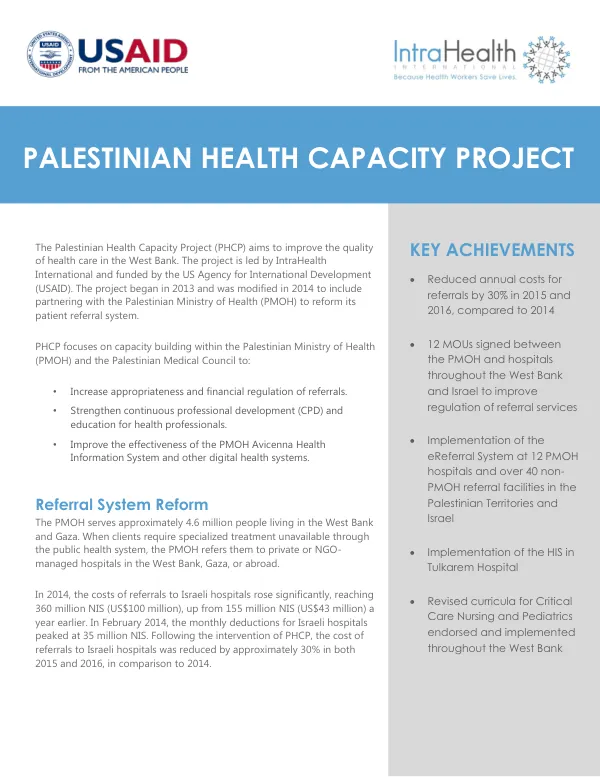
PHCP is led by IntraHealth International and funded by the US Agency for International Development (USAID). The project began in 2013 and was modified in 2014 to include partnering with the Palestinian Ministry of Health (PMOH) to reform its patient referral system. PHCP focuses on capacity building within the PMOH and the Palestinian Medical Council to increase appropriateness and financial regulation of referrals, strengthen continuous professional development (CPD) and education for health professionals, and improve the effectiveness of the PMOH Avicenna Health Information System and other digital health systems. The PMOH serves approximately 4.6 million people living in the West Bank and Gaza, and when clients require specialized treatment unavailable through the public health system, the PMOH refers them to private or NGO-managed hospitals in the West Bank, Gaza, or abroad. In 2014, the costs of referrals to Israeli hospitals rose significantly, reaching 360 million NIS (US$100 million), up from 155 million NIS (US$43 million) a year earlier. Following the intervention of PHCP, the cost of referrals to Israeli hospitals was reduced by approximately 30% in both 2015 and 2016, in comparison to 2014. PHCP partners with the PMOH to develop and implement guidelines and protocols to improve the appropriateness of referrals made to non-PMOH hospitals. PHCP provides technical assistance in monitoring and auditing referrals and in negotiating memoranda of understanding (MOUs) with referral hospitals to regulate service prices. Two PHCP innovations—the digital eReferral System and customer service centers—help the PMOH enhance its management of the referral process. These system improvements standardize the flow of referrals, making sure all stakeholders are aware of and able to approve or track the referral and its cost as needed. PHCP also aims to improve health education, continuous professional development programs, and health worker licensing and certifications systems to ensure the readiness of health workers to address increasing demand for specialized services. Improvements include revising and implementing the Palestinian residency program curricula, enhancing capacity in critical care for nurses, setting exam methodologies, and upgrading the Palestine Medical Council's Medical Exam Evaluation and Continuous Medical Education Systems. PHCP is also partnering with the PMOH and other stakeholders to improve governance, oversight, and use of the Avicenna Health Information System (HIS).