CENTER FOR EDUCATIONAL DEVELOPMENT
PAQUED Quarterly Report April 1 – June 30, 2011
The PAQUED project, implemented by Education Development Center, began in September 2009 with funding from USAID.
2011 · 24 pages
Sign in to readA free account is required to download.
Abstract
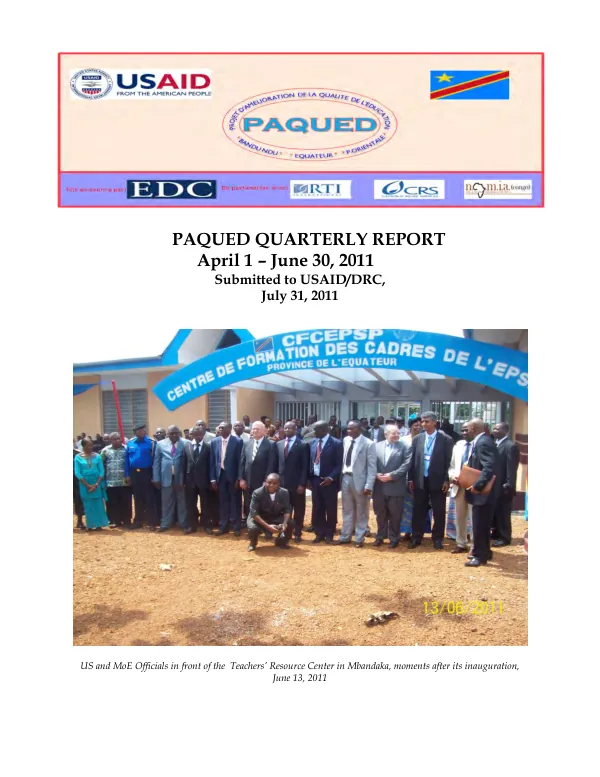
The project's main objective is to improve education quality in the Democratic Republic of Congo (DRC). During the reporting period of April 1 to June 30, 2011, the project's performance focused on several key activities. Continuing to broadcast Interactive Radio Instruction (IRI) programs was a major activity during this period. The project also distributed school kits to 3,000 partner schools, which was a significant logistical challenge due to the vast territory and poor road network in the three target provinces. The project used various transportation means, including aircrafts, bicycles, motorcycles, pirogues, and trucks, to reach the schools. The project also developed IRI programs for grades 3 and 4, prepared a teachers' professional development institute, and completed and inaugurated two resource centers in Bandundu and Mbandaka. Additionally, the project broadcast the first generation of community radio programs and developed a second generation of community radio programs. The project's staff underwent significant changes during this period, with the hiring of a new M&E Director, Anaclet Nlandu, and a new Finance Director, Mr. Albert Diasividi. The project also recruited three provincial M&E Assistants, who will join the project in the next quarter. The distribution of school kits was a major logistical challenge, but it was successfully carried out. The kits were received with enthusiasm by the beneficiaries, including teachers, students, and parents, as well as local MEPSP officials. There were only a few reported cases of damaged kits or kits with missing items. Teachers in the targeted schools continued to meet with their School Cluster Facilitators to view and discuss the content of the self-directed video learning modules. However, several factors slowed progress and reporting on this result, including the delayed distribution of school kits. The project's programmatic achievements during this period were significant, with the development of IRI programs for grades 3 and 4, the preparation of a teachers' professional development institute, and the completion and inauguration of two resource centers. The project also broadcast the first generation of community radio programs and developed a second generation of community radio programs. The project's monitoring and evaluation activities during this period included the development of a database, the implementation of the Early Grade Reading Assessment (EGRA) and Early Grade Math Assessment (EGMA), and the collection of baseline observation data. The project also identified new opportunities and trends, including the need to improve the project's monitoring and evaluation system. The project's success story during this period was the successful distribution of school kits to 3,000 partner schools, which was a significant logistical challenge. The project's accomplishments versus planned activities during this period were also significant, with the completion of several key activities and the development of new programs and initiatives. The project's challenges during this period included the delayed distribution of school kits, the need to improve the project's monitoring and evaluation system, and the need to address the logistical challenges of working in a vast and remote territory. The project's calendar for the next quarter includes several key activities, including the recruitment of three provincial M&E Assistants and the implementation of several new programs and initiatives.
Related documents